Codeine Interaction Risk Checker
Select the medication you are currently taking to see if it reduces the effectiveness of Codeine.
Result Title
Description goes here.
--
--
Recommendation
Advice text goes here.
You take your painkiller. You wait. Nothing happens. The headache is still there. The post-surgery ache hasn't budged. You might think the medication is weak or that you need a higher dose. But if you are also taking an antidepressant like Fluoxetine (Prozac) or Paroxetine (Paxil), the problem isn't the painkiller's strength. It’s a biological roadblock inside your liver.
This is not a rare side effect. It is a well-documented pharmacological collision known as the CYP2D6 inhibition interaction. When these specific drugs mix, they can render codeine completely useless. This article breaks down why this happens, which other medications cause similar issues, and what alternatives actually work for pain relief when you are on antidepressants.
The Mechanism: Why Codeine Needs Help to Work
To understand why this interaction causes pain relief to fail, we first have to look at how codeine works. Unlike morphine or oxycodone, which hit your brain directly, codeine is a prodrug. A prodrug is an inactive substance that must be converted by the body into its active form before it can provide therapeutic effects.
Codeine itself does almost nothing for pain. Your liver has to transform it into morphine. This transformation relies entirely on a specific enzyme called CYP2D6. Cytochrome P450 2D6 is a liver enzyme responsible for metabolizing approximately 25% of all commonly prescribed drugs.
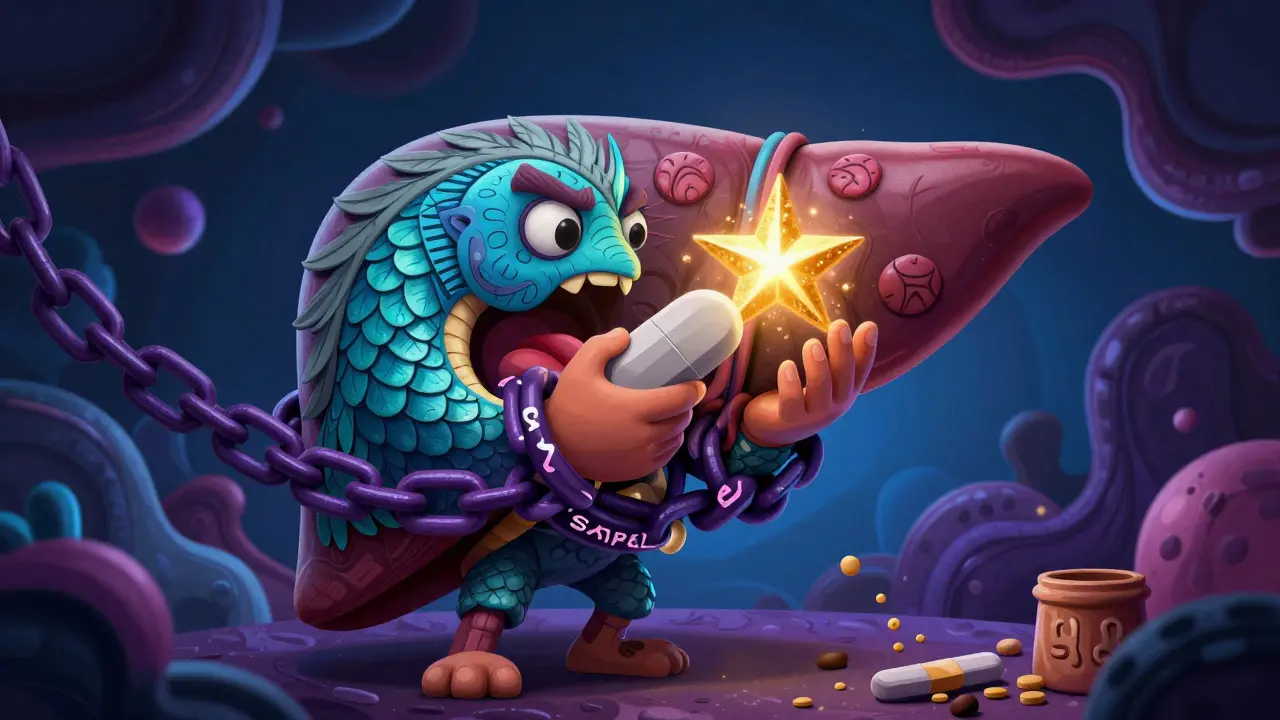
Think of CYP2D6 as a factory worker. Its job is to take the raw material (codeine) and turn it into the finished product (morphine). If the worker is busy with something else, or if someone ties their hands behind their back, the production line stops. No morphine is made. No pain relief occurs.
Research from the 1970s established that only about 5-10% of a codeine dose converts to morphine in healthy individuals. But when you introduce a potent inhibitor, that conversion rate drops to near zero.
The Blockers: How SSRIs Shut Down the Enzyme
Not all antidepressants block this process equally. Selective Serotonin Reuptake Inhibitors (SSRIs) vary widely in how much they interfere with liver enzymes. However, two stand out as major troublemakers: Fluoxetine and Paroxetine.
Paroxetine is one of the most potent clinical inhibitors of CYP2D6 identified. Studies show it has a Ki value (a measure of inhibitory strength) of 0.14 µM. For context, lower numbers mean stronger inhibition. Fluoxetine follows closely with a Ki of 0.2 µM.
A landmark study published in *Clinical Pharmacology & Therapeutics* quantified this impact. When participants took paroxetine alongside codeine, their levels of morphine in the blood dropped by 85%. Their total exposure to the drug (Area Under the Curve) fell by 78%. Effectively, the antidepressant turned normal metabolizers into "poor metabolizers," making the codeine chemically inert.
| Antidepressant | Inhibition Strength | CYP2D6 Activity Reduction | Risk with Codeine |
|---|---|---|---|
| Paroxetine (Paxil) | Strong | ~91% | Very High |
| Fluoxetine (Prozac) | Strong | ~78% | High |
| Sertraline (Zoloft) | Moderate | ~59% | Moderate |
| Citalopram (Celexa) | Weak/Minimal | <10% | Low |
If you are taking sertraline, the risk is lower but still present. If you are on citalopram or escitalopram, the interaction is minimal because these drugs barely touch the CYP2D6 enzyme.

Clinical Reality: What Happens When They Mix?
The theoretical chemistry translates to real-world suffering. A randomized controlled trial published in *Anesthesiology* looked at patients who had taken paroxetine for seven days before receiving codeine for pain. The result? They experienced 62% less pain relief compared to those not on the antidepressant. Their plasma morphine concentrations were down 83%.
This isn't just a slight reduction. It is often a complete failure of therapy. Patients report taking standard doses of codeine and feeling absolutely no difference. This leads to dangerous behaviors, such as doubling the dose without medical advice, which can lead to toxicity from unmetabolized codeine accumulation without providing any pain relief.
Data from the FDA Adverse Event Reporting System supports this. Between 2010 and 2020, there were hundreds of reports specifically citing "inadequate analgesia" linked to codeine-paroxetine combinations. The reporting odds ratio was significantly higher than expected, confirming that clinicians and patients frequently encounter this issue.
Better Alternatives for Pain Management
If you need pain relief while taking fluoxetine or paroxetine, codeine is not the right tool. Fortunately, there are effective alternatives that do not rely on CYP2D6 for activation.
- Oxycodone: This opioid is metabolized primarily by CYP3A4, a different enzyme pathway. It does not require conversion by CYP2D6 to become active. Studies show no significant interaction between oxycodone and strong CYP2D6 inhibitors.
- Morphine: Since morphine is already the active molecule, it bypasses the metabolic bottleneck entirely. It provides consistent pain relief regardless of your CYP2D6 status.
- Hydromorphone: Similar to morphine, hydromorphone is an active opioid that does not depend on CYP2D6 for its efficacy.
- Non-Opioid Options: Depending on the type of pain, NSAIDs (like ibuprofen or naproxen) or acetaminophen may be sufficient and carry no interaction risk with SSRIs regarding efficacy (though bleeding risks should always be monitored).
Switching from codeine to oxycodone or morphine in patients on these antidepressants typically results in immediate and adequate pain control, as seen in numerous clinical case studies.

What About Genetic Testing?
Your genetics play a role here too. Some people are born with naturally low CYP2D6 activity (Poor Metabolizers), while others have very high activity (Ultrarapid Metabolizers). Adding a drug inhibitor like paroxetine mimics the "Poor Metabolizer" genotype artificially.
The Clinical Pharmacogenetics Implementation Consortium (CPIC) explicitly advises against using codeine with strong CYP2D6 inhibitors. They state that this combination reduces efficacy significantly. While genetic testing can tell you your natural baseline, the presence of fluoxetine or paroxetine overrides your genetics, forcing your body into a poor metabolizer state regardless of your DNA.
Practical Steps for Patients and Providers
If you are currently on an SSRI and have been prescribed codeine, do not assume it will work. Here is what you should do:
- Inform your prescriber: Tell every doctor who prescribes you pain medication that you are taking fluoxetine, paroxetine, or bupropion (another strong inhibitor).
- Ask for alternatives: Request opioids that do not require CYP2D6 activation, such as oxycodone or hydrocodone (which has multiple metabolic pathways).
- Monitor effectiveness: If you must take codeine, monitor your pain levels closely. If you feel no relief after the first few doses, contact your doctor immediately. Do not increase the dose on your own.
- Check other meds: Remember that other drugs like quinidine, amiodarone, and duloxetine also inhibit CYP2D6. The interaction isn't limited to antidepressants.
Hospitals are increasingly adopting screening protocols. One health system reported that simply checking for CYP2D6 inhibitors before prescribing codeine reduced treatment failures by over 60% within a year. This simple check can save you from unnecessary pain and frustration.
Does codeine stop working if I take Prozac?
Yes. Fluoxetine (Prozac) is a strong inhibitor of the CYP2D6 enzyme. Since codeine needs this enzyme to convert into morphine, fluoxetine blocks this process. Most users experience significantly reduced or completely absent pain relief when taking both drugs together.
Is Paxil worse than Zoloft for interacting with codeine?
Generally, yes. Paroxetine (Paxil) is a more potent CYP2D6 inhibitor than sertraline (Zoloft). Paroxetine can reduce CYP2D6 activity by up to 91%, whereas sertraline reduces it by about 59%. Both can impair codeine's effectiveness, but the risk is higher with paroxetine.
What painkillers are safe to take with SSRIs?
Opioids like oxycodone, morphine, and hydromorphone are safer choices because they do not rely on CYP2D6 for activation. Non-opioid options like acetaminophen or NSAIDs (ibuprofen) are also generally safe regarding efficacy, though you should consult your doctor about bleeding risks with NSAIDs.
Can I increase my codeine dose to overcome the interaction?
No. Increasing the dose is dangerous and ineffective. Because the metabolic pathway is blocked, higher doses of codeine will not convert to morphine. Instead, you risk accumulating toxic levels of unmetabolized codeine in your system without getting pain relief. Always switch to a different medication under medical supervision.
How long does the interaction last after stopping the antidepressant?
The duration depends on the half-life of the drug. Fluoxetine has a very long half-life (up to several weeks due to its active metabolite norfluoxetine), so the interaction can persist for weeks after stopping. Paroxetine clears faster, usually within a week or two. Consult your pharmacist for specific timelines based on your dosage.
Jonathan Paul
June 4, 2026 AT 07:29Rachel Harrypersad
June 5, 2026 AT 16:11ANGELA CHINENYE
June 7, 2026 AT 15:09Dave Villeneue
June 8, 2026 AT 00:31Aishwarya Thankachan
June 8, 2026 AT 06:23Lenny Cruz
June 9, 2026 AT 21:23Jennifer Legore
June 10, 2026 AT 03:24Jerry Mathews
June 10, 2026 AT 04:07Aswin Narayan J
June 10, 2026 AT 07:07Francis Saul
June 10, 2026 AT 20:00Brian Irwin
June 10, 2026 AT 20:00Roderick Gooden
June 11, 2026 AT 21:55