
When you pick up a prescription at the pharmacy, you might not think about whether the pill in your hand is exactly the same as the brand-name version. But behind the scenes, the FDA uses a precise system to decide if a generic drug can safely replace the original. This system is called therapeutic equivalence, and it’s tracked through a set of codes you’ll find in the FDA’s Orange Book. These codes aren’t just bureaucratic labels-they directly affect whether you get a cheaper generic, and whether your pharmacist can swap it without asking your doctor.
What Do Therapeutic Equivalence Codes Actually Mean?
Therapeutic equivalence codes are the FDA’s way of saying: “This generic drug works just like the brand-name version.” It’s not enough for a generic to have the same active ingredient, strength, and pill shape. The FDA requires proof that it behaves the same way in your body. That means the drug must be absorbed at the same rate and to the same extent as the original. If it passes that test, it gets an A rating. If not, it gets a B.These codes appear next to every multisource drug in the Orange Book, the official FDA publication that lists approved drugs and their substitution ratings. The system started in 1980, but it became critical after the 1984 Hatch-Waxman Act, which made it easier for companies to bring generics to market. Today, over 90% of generic drugs in the U.S. have an A rating.
The Letter System: A, AB, B, and Beyond
The code isn’t just one letter. It’s a combination that tells pharmacists exactly what they’re dealing with.- A-rated drugs are interchangeable. They’re pharmaceutical equivalents (same ingredient, dose, form) and have proven bioequivalence through testing. Most oral tablets and capsules fall into this category.
- AB is the most common A-subtype. It means the drug meets all bioequivalence standards. But if there are multiple brand-name versions of the same drug, the FDA adds numbers: AB1, AB2, AB3. You can only swap between products with the same number. For example, AB1 can be substituted for another AB1, but not for AB2.
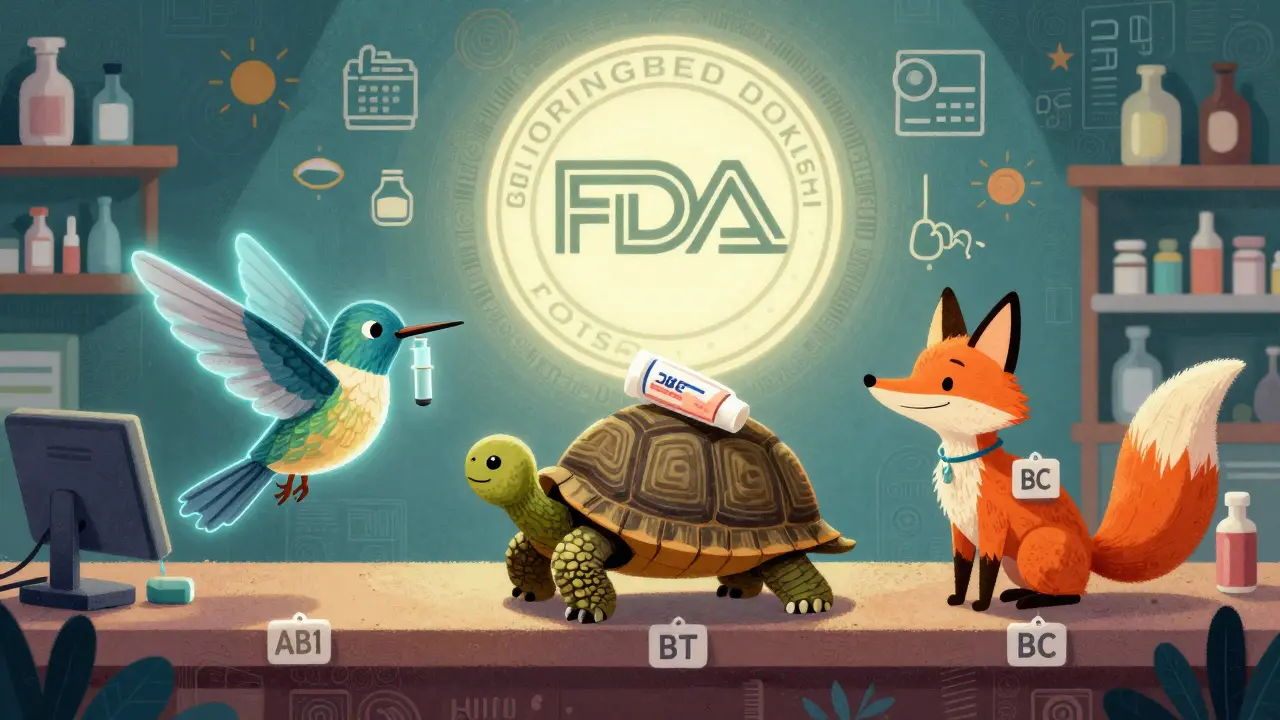
- B-rated drugs are not automatically interchangeable. They may have the same ingredients but lack proven bioequivalence. Some B codes have extra letters to explain why: BC for extended-release, BT for topical creams, BX for not enough data. These require extra caution.
Why does this matter? Because state laws let pharmacists substitute A-rated drugs without asking the doctor. In 49 states, if your prescription says “Lisinopril,” and the pharmacy has an AB-rated generic, they can hand it to you without calling your doctor. But if it’s a BT-rated topical cream? They can’t swap it. The law says no.
Why Some Generics Get B Ratings-Even When They Should Work
It’s frustrating, but true: some generic drugs that seem identical to the brand get a B rating. Why? Because the FDA’s current testing methods don’t always capture how complex drugs behave in the body.Take topical creams. You can measure how much drug is in the cream, but you can’t easily test how much gets into the skin. A cream might look the same, feel the same, and have the same ingredients-but if it doesn’t penetrate the skin the same way, the FDA can’t say it’s therapeutically equivalent. So it gets a BT code.
Same with inhalers, injectables, and extended-release pills. For these, the body doesn’t just absorb the drug-it releases it slowly over time. Testing that requires more than just blood samples. It needs real-world data on how patients respond. Right now, the FDA mostly relies on lab tests, which sometimes miss the mark.
Dr. Duxin Sun from the University of Michigan points out that this creates a gap: some B-rated drugs are just as effective as the brand, but pharmacists are legally barred from substituting them. That means patients pay more than they should.
How Pharmacists Use the Orange Book Every Day
Pharmacists don’t guess. They check the FDA’s Orange Book-online, every time they fill a prescription. In a 2022 survey, 87% of independent pharmacists said they consult it at least once a week. For complex cases, they might check it multiple times.When a patient walks in with a prescription for a drug like Simvastatin, the pharmacist looks up the brand name, finds the generic alternatives, and checks the TE code. If it’s AB, they substitute. If it’s BX, they call the doctor. That process takes about 2.7 minutes per prescription. Multiply that by millions of prescriptions a year, and you get $1.2 billion in savings.
But confusion still happens. A 2022 American Medical Association survey found that 42% of physicians didn’t fully understand B codes. Some thought a BC-rated extended-release drug couldn’t be swapped at all-even though many BC products are clinically identical. That led to patients being denied cheaper options unnecessarily.
What’s Changing in 2026?
The FDA knows the system has limits. In 2022, it released a draft guidance proposing updates to how it evaluates complex drugs. The goal? Reduce B ratings for products that are actually equivalent.One big change coming: more use of real-world evidence. Instead of relying only on lab tests, the FDA is starting to look at how patients actually respond in clinics. If hundreds of patients use a generic topical cream and get the same results as the brand, that counts. It’s slower than lab testing, but more accurate.
The agency is also expanding its Product-Specific Guidelines-1,850 of them now-to give manufacturers clearer rules on how to prove bioequivalence. This should help more generics get A ratings.
The long-term plan? Cut B-rated products for complex generics by 30% by 2027. That means more affordable options, fewer barriers, and better access.

Why This Matters to You
You might think this is just a pharmacy rule. But it’s about your wallet, your health, and your choices.Generic drugs make up 90% of prescriptions in the U.S. but only 23% of drug spending. That’s $370 billion saved every year. That money comes from the FDA’s ability to say, “Yes, this generic is just as good.” Without therapeutic equivalence codes, pharmacists couldn’t substitute. Doctors would have to write separate prescriptions for each brand. Insurance companies would pay more. You’d pay more.
And if you’re on a complex drug-like an inhaler for asthma or a topical treatment for eczema-you might be paying more than you need to because the system hasn’t caught up. The FDA is working on it. But until then, knowing what the codes mean helps you ask the right questions.
What to Do Next
If you’re prescribed a generic:- Ask your pharmacist: “What’s the TE code?”
- If it’s AB, you’re good to go.
- If it’s B, ask: “Why? Is there a reason I can’t use a cheaper version?”
- Check the FDA’s Orange Book yourself at accessdata.fda.gov-search by drug name and look for the “Therapeutic Equivalence” column.
You don’t need to be an expert. But understanding that A means interchangeable and B means “check first” puts you in control. And that’s how you get the right drug at the right price.
What does an AB rating mean for my generic drug?
An AB rating means the generic drug is therapeutically equivalent to the brand-name version. It has the same active ingredient, strength, dosage form, and route of administration, and it has passed FDA bioequivalence testing. Pharmacists can substitute it without your doctor’s permission in most states.
Can I always substitute an A-rated generic for a brand-name drug?
In 49 U.S. states, yes-unless your doctor writes "dispense as written" on the prescription. The law allows pharmacists to substitute A-rated generics automatically. But you can’t swap between AB1 and AB2 products-they’re considered different by the FDA. Always check the full code, not just the A.
Why does my generic have a B rating if it looks the same as the brand?
A B rating doesn’t mean the drug is unsafe or ineffective. It means the FDA hasn’t confirmed it works the same way in your body. This often happens with complex products like inhalers, creams, or extended-release pills, where standard blood tests can’t fully measure how the drug behaves. The FDA is working on better methods, but for now, substitution isn’t allowed.
Do over-the-counter drugs have therapeutic equivalence codes?
No. The FDA’s therapeutic equivalence system only applies to prescription drugs listed in the Orange Book. OTC medications like ibuprofen or antacids aren’t rated because they’re not subject to the same substitution laws. Pharmacists can still recommend alternatives, but there’s no official TE code.
How often does the FDA update therapeutic equivalence codes?
The FDA updates the Orange Book monthly. New drugs are added, existing codes are changed, and some products get upgraded from B to A as new data becomes available. You can check the latest version online at the FDA’s website. Pharmacists rely on these updates to make safe substitution decisions.
Janelle Pearl
March 9, 2026 AT 02:56Just read this and honestly? I had no idea how much goes into whether my generic pill is safe to swap. I always assumed if it looked the same, it was the same. Turns out, my pharmacist is doing way more homework than I ever gave them credit for. Thanks for breaking this down so clearly.
Ray Foret Jr.
March 10, 2026 AT 16:57AB rating = go for it 😊 I always ask my pharma if it’s AB and they’re always like ‘yep, totally fine’ 🙌 glad the system works
Robert Bliss
March 11, 2026 AT 18:40So if it’s AB1 and I get AB2, I can’t swap? That’s kinda wild. I thought all ABs were the same. Guess I gotta pay attention to the number too. Thanks for the heads up!
Peter Kovac
March 12, 2026 AT 18:36The assertion that B-rated drugs are inherently inferior is misleading. The FDA’s methodology is not flawed-it is deliberately conservative. Bioequivalence is not a binary metric; it is a statistical construct with narrow confidence intervals designed to prevent marginal differences from being normalized. To conflate therapeutic equivalence with clinical equivalence is a fundamental error in pharmacokinetic reasoning.
APRIL HARRINGTON
March 14, 2026 AT 14:24OMG I JUST FOUND OUT MY ASTHMA INHALER IS B RATED AND I’VE BEEN PAYING $120 A MONTH?? I’M SO ANGRY 😭 WHY DOESN’T ANYONE TELL YOU THIS?? I’M CALLING MY DOCTOR RIGHT NOW
Leon Hallal
March 16, 2026 AT 12:42This is all just corporate nonsense. They want you to think generics are safe so they can keep charging you for the brand. The FDA is in bed with Big Pharma. You think they really test all this stuff? Nah. They just rubber stamp it. I’ve been on generics for years and I swear I feel worse. Coincidence? I think not.
Judith Manzano
March 17, 2026 AT 20:58That part about real-world evidence being used more by 2026 is super promising. I’ve got a cousin on a topical cream that’s B-rated and she’s been stuck paying double for years. If they start using actual patient data instead of just lab tests, that could change so much. Hope they move fast.
rafeq khlo
March 18, 2026 AT 15:19The FDA system is a joke. In India we do not have such complicated codes. If the generic has same ingredient and same dosage it is interchangeable. Why does America need so many letters and numbers? This is overregulation. You are making medicine inaccessible with bureaucracy. The people suffer because of your system
Morgan Dodgen
March 19, 2026 AT 09:14AB1, AB2… sounds like a corporate scheme to lock patients into brand loyalty under the guise of ‘science’. The FDA doesn’t have the tech to test complex delivery systems? Bullshit. They’re being paid off. Why else would they delay updates? Look at the 1,850 Product-Specific Guidelines-each one is a loophole for pharma to game the system. This isn’t about safety. It’s about profit. And you? You’re the sucker paying for it.
Philip Mattawashish
March 20, 2026 AT 20:19People don’t realize how dangerous this system is. You think your pharmacist knows what they’re doing? They’re just following a checklist. Half of them don’t even understand the difference between AB and A. And doctors? They’re clueless. This isn’t healthcare. It’s a lottery. And the house always wins. You’re not saving money-you’re risking your life for a few bucks.
Tom Sanders
March 22, 2026 AT 11:57Yeah I get it. But honestly I just take whatever they give me. If it works, it works. If it doesn’t, I go back. Seems like overthinking it to me.
Stephen Rudd
March 22, 2026 AT 16:34Let me get this straight-you’re celebrating a system that lets pharmacists swap drugs without a doctor’s input? In Australia, we require explicit approval for any substitution. You Americans are too trusting. This is how people get poisoned. Your system is a disaster waiting to happen.
Mantooth Lehto
March 23, 2026 AT 23:30My pharmacist swapped my B-rated cream for a generic and my skin went nuts. I had a full-on breakout. Now I know better. They don’t care about you. They just want to hit their quota. I’m never letting them swap again. Ever.
Melba Miller
March 25, 2026 AT 05:26Why are we letting foreign companies make our generics? The FDA should only approve American-made drugs. This whole system is just a backdoor for China and India to flood our market with cheap crap. We need to rebuild our domestic pharma industry. No more foreign generics. Not after what happened with the baby formula crisis.
Katy Shamitz
March 25, 2026 AT 07:45Y’all are overcomplicating this. If the generic works, use it. If it doesn’t, switch back. Simple. I’ve been on generics for 15 years, never had an issue. Stop being so paranoid. The FDA isn’t perfect, but they’re not trying to kill you. 😘