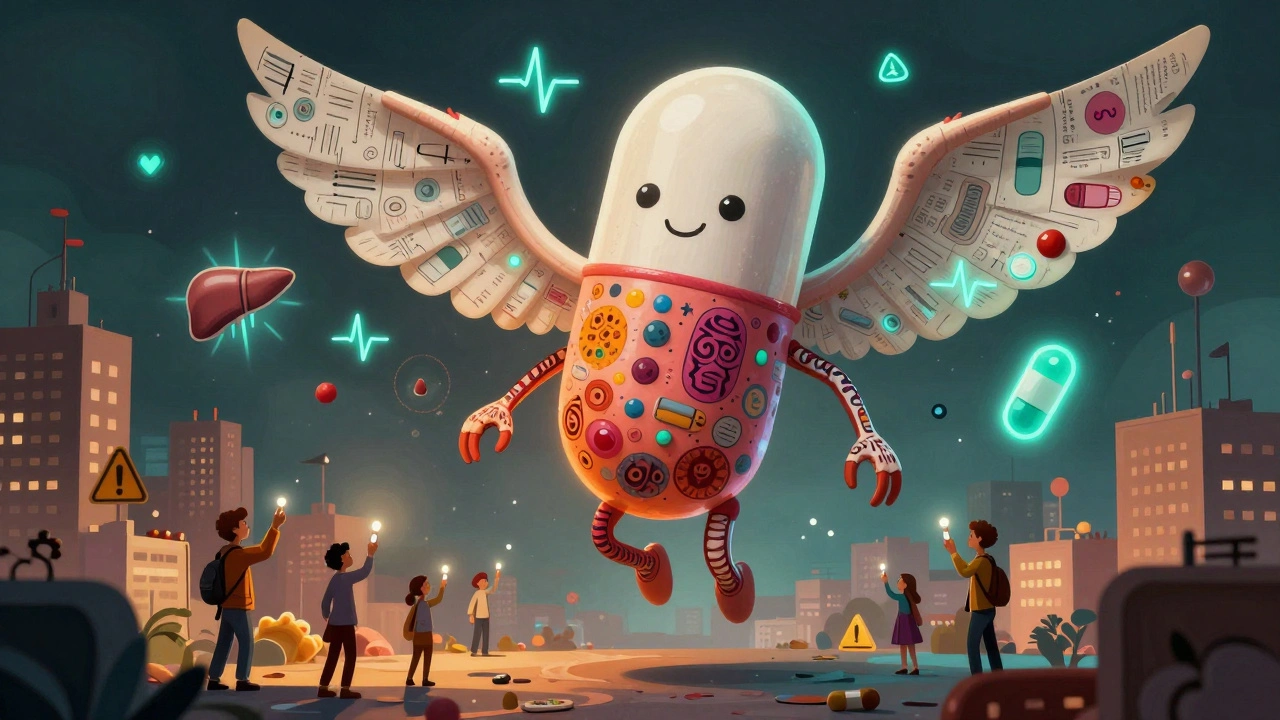
Every time you take a pill, there’s a quiet calculation happening behind the scenes. Not in your body-though that matters too-but in the world of science, regulation, and data. Medication safety isn’t just about reading the label or avoiding interactions. It’s about understanding medication safety as a living science, built on decades of lessons learned from tragedy, refined by massive datasets, and constantly updated as millions of people use drugs in real life-not just in controlled trials.
Why Clinical Trials Aren’t Enough
When a new drug hits the market, it’s been tested in thousands of people over months or a couple of years. That sounds solid-until you realize that if a side effect happens in just 1 in 10,000 patients, it’s almost guaranteed to be missed. The average Phase III trial includes fewer than 1,000 participants. That’s not enough to catch rare but serious reactions like liver failure, dangerous heart rhythms, or sudden neurological damage. These events don’t show up in labs or hospital wards during the trial. They show up months or years later, in grandma’s kitchen, in a busy ER, or in a rural clinic with no specialist nearby. That’s where real-world evidence steps in. After approval, drugs are used by millions-older adults, pregnant women, people with five other conditions, those taking over-the-counter supplements. These are the people left out of trials. And that’s exactly where the biggest risks hide.The Tools That Keep Us Safe
Scientists don’t guess. They use tools built for scale and precision. One of the most powerful is the observational study. Unlike randomized trials, these don’t assign people to drugs. They watch what happens naturally. Think of it like tracking traffic patterns after a new road opens-you don’t force cars to go one way; you just see where the accidents happen. There are three main types:- Cohort studies: Follow groups of people who took a drug versus those who didn’t, over time.
- Case-control studies: Look back at people who had a bad reaction and compare their drug history to others who didn’t.
- Self-controlled designs: Compare each person’s risk when they’re taking the drug versus when they’re not. This cuts out individual differences-like age or genetics-that can muddy the results.
The Hidden Flaws in the System
It’s not perfect. Even with huge data, problems creep in. One big one? Confounding. If people taking a certain blood pressure drug also tend to be older, sicker, or less active, it’s hard to tell if a heart attack was caused by the drug-or by their lifestyle. Statisticians use tricks like propensity score matching to balance these factors. Good studies can get 85-95% of the differences under control. But 5-15%? That’s still noise. And that’s where false alarms happen. Another problem: alert fatigue. Hospitals use computer systems to warn doctors about dangerous drug combinations. But if a nurse gets 20 alerts a shift-and 18 of them are for minor, harmless interactions-they stop paying attention. One study found prescribers override 89% of drug interaction alerts. That’s not negligence. It’s burnout. And then there’s data quality. Administrative databases-like insurance claims-are full of gaps. Did the patient actually take the pill? Did they get a refill? Was the dose recorded right? Studies estimate 15-25% of medication records in these systems are incomplete or wrong. That’s like trying to map a city using only every third street sign.
Who’s Watching?
This isn’t left to chance. In the U.S., the FDA, NIH, and Patient-Centered Outcomes Research Institute (PCORI) lead the charge. Globally, the International Society of Pharmacoepidemiology connects over 3,500 researchers. After the thalidomide disaster in the 1960s-where thousands of babies were born with severe limb defects-regulators realized they couldn’t wait for harm to happen before acting. Today, the FDA requires Risk Evaluation and Mitigation Strategies (REMS) for high-risk drugs. That might mean special training for doctors, restricted distribution, or mandatory patient monitoring. For opioids, it’s led to stricter prescribing rules. For certain antipsychotics, it means regular liver tests. In 2023, 37% of newly approved drugs came with post-market safety studies attached. That’s not a penalty. It’s a promise: we’ll keep watching.Real Wins, Real Failures
This science saves lives. At Kaiser Permanente Washington, a standardized protocol for treating alcohol withdrawal with phenobarbital cut severe withdrawal cases by 42% across 12 hospitals. That’s not theory. That’s 150 people avoided ICU stays. But failures are just as telling. A 2022 review in JAMA Internal Medicine found that 22% of the “significant” drug risks found in observational studies were later disproven by randomized trials. That’s not a failure of the science-it’s a reminder that correlation isn’t causation. A drug might be taken by people who are already sicker. The signal gets lost in the noise. Frontline staff know this best. Nurses in AHRQ focus groups reported near-miss errors weekly because of fragmented EHR systems and poor communication between doctors, pharmacists, and patients. One nurse said, “I’ve seen the same patient get three different doses of the same drug because three different systems didn’t talk to each other.”
The Future Is Real-Time
The next leap? Real-time monitoring. The FDA’s Sentinel System 3.0, launched in 2023, can now flag potential safety signals within days-not months. It’s like having a smoke alarm that doesn’t wait for the fire to spread. New tools are emerging too. AI models are being trained to predict which patients are most likely to have a bad reaction based on their medical history, genetics, and even social factors like income or access to pharmacy services. Early tests show 22-35% fewer high-alert medication errors when these systems are used. By 2025, the FDA plans to start incorporating data from wearables-heart rate spikes, sleep patterns, activity levels-to detect early signs of drug toxicity. Imagine knowing your blood thinner is causing an irregular heartbeat before you even feel dizzy.What You Can Do
You don’t need to be a scientist to help. Here’s how:- Keep an updated list of every medication you take-including vitamins, supplements, and over-the-counter drugs. Share it with every provider.
- Ask questions: “What’s this for?” “What are the most common side effects?” “What should I do if I feel worse?”
- Report side effects. The FDA’s MedWatch program lets patients report adverse events directly. One report won’t change the world. But 10,000? That’s how a hidden risk becomes a warning.
- Use one pharmacy. It helps them catch dangerous combinations you didn’t even know existed.
Final Thought: Safety Is a Conversation
Medication safety isn’t a checklist. It’s a conversation between science and lived experience. Between data and doctors. Between regulators and patients. The best evidence doesn’t come from a lab. It comes from the real world-where people live, take pills, get sick, and recover. The science is evolving. The tools are getting smarter. But the goal hasn’t changed: to make sure the medicine that helps you doesn’t hurt you.How are drug risks identified after a medication is approved?
After approval, drug safety is monitored through large-scale observational studies using real-world data from electronic health records, insurance claims, and national health databases. Systems like the FDA’s Sentinel Initiative track millions of patients to detect rare or delayed side effects that weren’t visible in clinical trials. Reports from patients and healthcare providers through programs like MedWatch also help flag potential issues.
Why do some drug warnings turn out to be wrong?
Early signals from observational studies can sometimes be misleading because they can’t fully control for other factors-like age, existing health conditions, or lifestyle-that may be the true cause of an adverse event. A drug might be taken by sicker patients, making it look dangerous when it’s not. That’s why follow-up randomized trials or more refined analyses are often needed to confirm or rule out a risk.
What’s the difference between a side effect and an adverse drug event?
A side effect is any effect of a drug that’s not the intended one-some are harmless, like dry mouth from antihistamines. An adverse drug event (ADE) is a harmful or unintended consequence that results in injury, hospitalization, or death. Not all side effects are ADEs, but all ADEs start as side effects that went too far.
Can I trust drug safety data from pharmaceutical companies?
Pharmaceutical companies are required to report adverse events to regulators, but independent oversight is critical. Agencies like the FDA and NIH analyze data from multiple sources-including public health systems and academic research-to verify findings. Transparency is improving, but independent studies using real-world data remain the gold standard for unbiased safety assessment.
How do I know if a medication is safe for me personally?
No drug is universally safe. Talk to your doctor or pharmacist about your full medical history, all medications you take (including supplements), allergies, and any past reactions. Ask if there are safer alternatives based on your age, kidney or liver function, or other conditions. Use one pharmacy so they can check for interactions. And never ignore new symptoms after starting a new drug-report them right away.
sean whitfield
December 6, 2025 AT 00:30Carole Nkosi
December 6, 2025 AT 15:38Stephanie Bodde
December 8, 2025 AT 07:24Philip Kristy Wijaya
December 10, 2025 AT 03:46Jennifer Patrician
December 12, 2025 AT 01:54Mellissa Landrum
December 12, 2025 AT 12:30Manish Shankar
December 13, 2025 AT 00:44luke newton
December 13, 2025 AT 12:05aditya dixit
December 15, 2025 AT 09:01Annie Grajewski
December 15, 2025 AT 12:46Jimmy Jude
December 17, 2025 AT 03:02Mark Ziegenbein
December 17, 2025 AT 09:48William Chin
December 18, 2025 AT 07:25Ada Maklagina
December 19, 2025 AT 18:24Harry Nguyen
December 20, 2025 AT 08:05