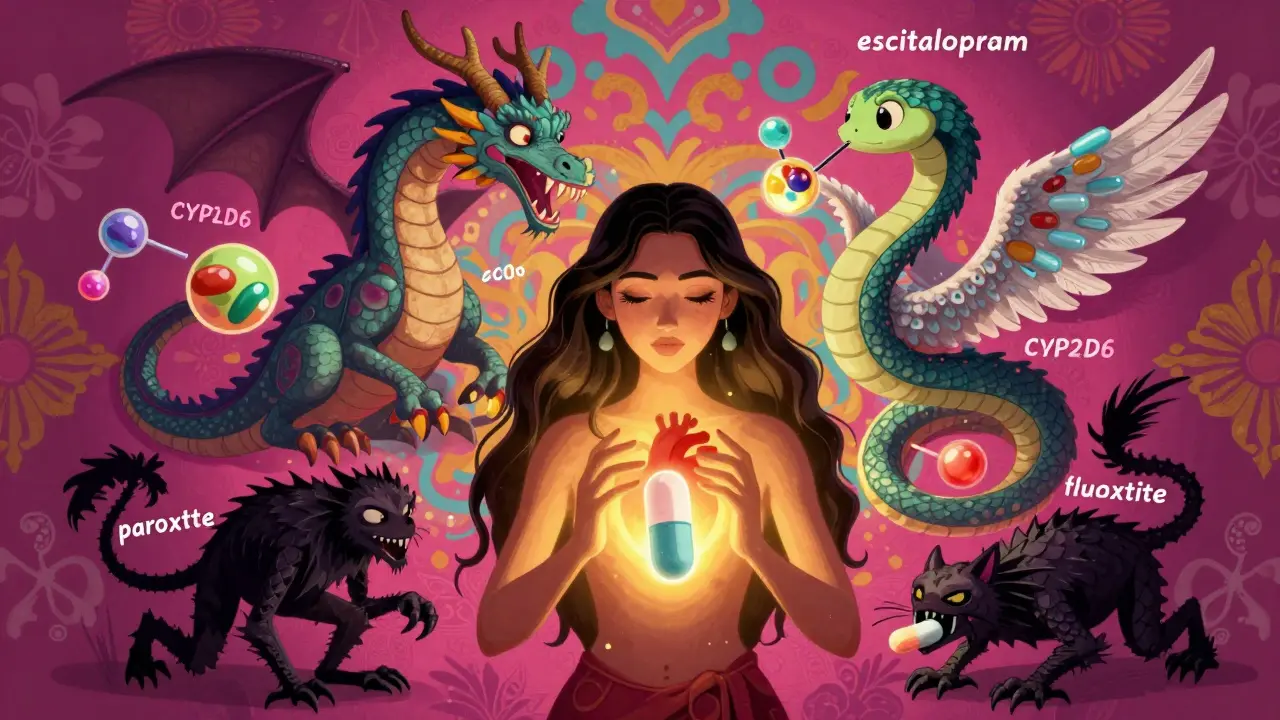
When a woman is diagnosed with estrogen receptor-positive breast cancer, tamoxifen is often the first line of treatment. It’s been used for decades, is affordable, and works well. But here’s the catch: many women taking tamoxifen also struggle with depression, anxiety, or hot flashes-side effects that can be just as debilitating as the cancer itself. That’s where SSRIs come in. These antidepressants are prescribed to help manage mood, but they might be quietly interfering with tamoxifen’s ability to do its job. The real question isn’t whether the interaction exists-it does. It’s whether it actually changes survival rates or increases the chance of cancer coming back.
How Tamoxifen Really Works
Tamoxifen isn’t active on its own. Think of it like a key that needs to be shaped before it fits into the lock. The body uses enzymes-mostly CYP2D6-to turn tamoxifen into endoxifen, the version that actually blocks estrogen in breast tissue. Endoxifen is 30 to 100 times stronger than tamoxifen at stopping cancer growth. If endoxifen levels drop too low, the drug might not work as well. That’s why researchers started looking at anything that could block CYP2D6.
SSRIs are common. About 1 in 5 women on tamoxifen will be prescribed one. But not all SSRIs are the same when it comes to this enzyme. Some are like a sledgehammer to CYP2D6. Others barely tap it.
The SSRI Ranking: Who’s a Strong Inhibitor?
Not all antidepressants are created equal here. Based on how tightly they bind to CYP2D6, they fall into clear categories:
- Strong inhibitors: Paroxetine (Paxil), fluoxetine (Prozac)
- Moderate inhibitors: Sertraline (Zoloft)
- Weak inhibitors: Citalopram (Celexa), escitalopram (Lexapro), venlafaxine (Effexor)
Paroxetine is the worst offender. A 2010 study from the Mayo Clinic found it slashed endoxifen levels by more than half. Fluoxetine sticks around in the body for weeks, so even if you stop taking it, its effect lingers. Sertraline is in the middle-enough to cause concern, but not as dramatic. Meanwhile, escitalopram and venlafaxine barely touch CYP2D6. That’s why oncologists now quietly steer patients away from paroxetine and toward escitalopram.
The Evidence Is Mixed-And That’s the Problem
Here’s where it gets messy. In the lab, the interaction is crystal clear. In real life, it’s not so obvious.
A 2009 Canadian study of 2,430 women found that those taking paroxetine with tamoxifen had a 24% higher risk of dying from breast cancer. The risk jumped to 90% if they took both for more than six months. That study shook the medical world. It led to warning labels, guidelines, and panic among patients.
But then came bigger studies. In 2016, researchers looked at over 16,000 women across a 14-year period. They found no increase in cancer recurrence or death-even in those taking paroxetine. A Danish study of 16,000 women showed the same thing. A 2023 Bayesian analysis of nearly 4,500 women found a tiny increase in recurrence risk-but it was so small, it could have been random noise.
Why the contradiction? Small studies often miss things. Maybe they didn’t account for how advanced the cancer was. Maybe they didn’t track how long women took the drugs. Or maybe, as some experts argue, the body finds other ways to make endoxifen. CYP3A4 and CYP2C9 can pick up some of the slack. So even if CYP2D6 is blocked, the system doesn’t always collapse.

What the Guidelines Say Now
By 2022, the American Society of Clinical Oncology (ASCO) changed its stance. They no longer recommend testing for CYP2D6 gene variants. They also say: don’t avoid antidepressants just because they might interfere with tamoxifen. The reasoning? The clinical data doesn’t support it.
The National Comprehensive Cancer Network (NCCN) takes a slightly more cautious approach. They still recommend avoiding paroxetine and fluoxetine if possible. But they don’t say stop antidepressants. Instead, they say: pick the one that works best for the patient’s mood and side effects. That’s a big shift. It moves the focus from enzyme chemistry to human experience.
Even the FDA, which once flagged this interaction as a potential risk, now says: available data do not establish a clinically significant interaction. The European Medicines Agency still warns against strong inhibitors-but even they’re softening.
What’s Really Happening in Doctor’s Offices?
Real-world practice has already moved on. A 2022 survey of over 1,200 U.S. oncologists showed that 68% no longer avoid SSRIs with tamoxifen. That’s up from just 32% in 2015. Why? Because their patients weren’t getting better. They were depressed. They were quitting tamoxifen. They were skipping doses. The risk of recurrence from untreated depression was higher than the theoretical risk from a drug interaction.
Reddit threads from breast cancer support groups are full of women asking: “Should I switch from Paxil to Lexapro?” Many report their doctors now recommend escitalopram or venlafaxine. Hospitals have updated their electronic prescribing systems to flag paroxetine when tamoxifen is on the list. One study found that after adding these alerts, prescriptions of strong inhibitors dropped by 37%-without reducing overall antidepressant use.
The bottom line? Doctors aren’t afraid to prescribe antidepressants anymore. They’re just smarter about which ones they pick.

What Should You Do?
If you’re on tamoxifen and need help with mood or sleep:
- Don’t stop your antidepressant without talking to your doctor. Untreated depression can be more dangerous than any drug interaction.
- Ask about alternatives. If you’re on paroxetine or fluoxetine, ask if switching to escitalopram or venlafaxine is an option. Both are just as effective for depression and don’t interfere with tamoxifen.
- Don’t panic about genetic testing. CYP2D6 testing is not recommended by major guidelines. It doesn’t reliably predict outcomes.
- Track your symptoms. If you feel worse-more hot flashes, more fatigue, more mood swings-talk to your oncologist. It might not be the SSRI. It might be the tamoxifen.
Most importantly: your mental health matters. If you’re struggling, you’re not alone. And there are safe, effective ways to get help.
The Future: Is This Even Still a Debate?
The SWOG S1713 trial, expected to finish in 2025, is the first to directly test whether giving paroxetine to women on tamoxifen changes their endoxifen levels and cancer outcomes. It’s randomized, controlled, and designed to answer this question once and for all.
Meanwhile, experts are already moving on. Dr. Veronique Michaud, who led the 2023 study, predicts that by 2026, no one will be testing for CYP2D6 status in tamoxifen patients. It’ll be like the old days of testing for TPMT before giving 5-FU-another case where lab science didn’t match real-world results.
The German Breast Group still recommends genotyping. But most of the world is letting go. The evidence is clear: pharmacokinetics don’t always predict clinical outcomes.
What matters most isn’t the enzyme. It’s whether you can stick with your treatment. Whether you feel like yourself. Whether you’re alive and well five years from now. That’s the real goal.
Does taking an SSRI with tamoxifen increase my risk of breast cancer returning?
The evidence is mixed. Some studies suggest a small increase in recurrence risk with strong CYP2D6 inhibitors like paroxetine, especially with long-term use. But larger, more rigorous studies-including one tracking over 16,000 women for up to 14 years-found no significant increase in recurrence or death. Most major guidelines now conclude that the clinical impact, if any, is minimal. The priority should be treating depression effectively, not avoiding antidepressants out of theoretical risk.
Which antidepressants are safest to take with tamoxifen?
Escitalopram (Lexapro) and venlafaxine (Effexor) are the safest choices. Both have very weak effects on CYP2D6 and are just as effective for treating depression as stronger inhibitors like paroxetine. Citalopram (Celexa) is also a good option. Avoid paroxetine and fluoxetine if possible, since they significantly reduce endoxifen levels. But if you’re already on one of those and feeling stable, don’t switch without talking to your doctor-stopping an antidepressant can cause withdrawal or worsen mood.
Should I get tested for CYP2D6 gene variants?
No. Major guidelines from ASCO and the FDA no longer recommend routine CYP2D6 testing for women taking tamoxifen. While poor metabolizers do have lower endoxifen levels, studies haven’t shown that this consistently leads to worse cancer outcomes. Testing adds cost, anxiety, and confusion without improving care. Treatment decisions should be based on your symptoms, tolerance, and response-not a genetic test.
Can I switch from paroxetine to escitalopram safely?
Yes, but it must be done carefully. Switching antidepressants requires a gradual taper and a washout period, especially if you’re on fluoxetine, which stays in the system for weeks. Your oncologist or psychiatrist should guide this transition. Most patients tolerate the switch well, and many report improved mood stability once they move to escitalopram. The goal is to maintain mental health while minimizing any theoretical risk to tamoxifen’s effectiveness.
What if I can’t tolerate any SSRI? Are there other options?
Yes. Venlafaxine (Effexor) is an SNRI, not an SSRI, and has minimal CYP2D6 inhibition. It’s often used as an alternative. Non-SSRI options like bupropion (Wellbutrin) are also available, though they may not be ideal for everyone due to side effects like increased anxiety or insomnia. Therapy, mindfulness, or low-dose gabapentin for hot flashes may also help reduce the need for medication. Talk to your care team about a personalized plan.
Final Thought
The story of tamoxifen and SSRIs isn’t about perfect science. It’s about imperfect people trying to survive cancer while staying mentally whole. We used to think chemistry alone dictated outcomes. Now we know: the most powerful drug isn’t the one in the pill-it’s the one that lets you sleep, laugh, and keep showing up for your life.