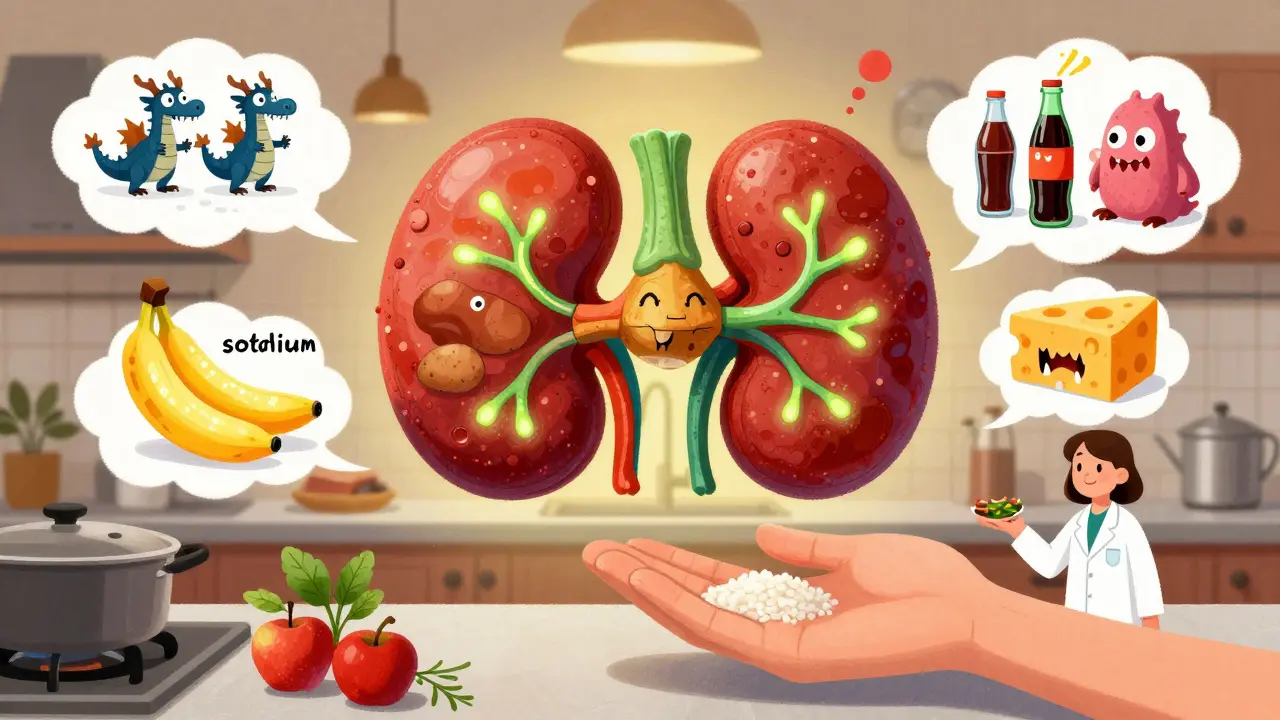
When your kidneys aren't working well, what you eat becomes just as important as any medication. A renal diet isn't about losing weight or eating "clean." It's a targeted, science-backed eating plan designed to keep dangerous minerals from building up in your blood. For people with chronic kidney disease (CKD), too much sodium, potassium, or phosphorus can lead to serious problems-high blood pressure, irregular heartbeat, bone damage, or even heart failure. The good news? With the right food choices, you can slow down kidney damage, feel better, and delay the need for dialysis.
Why Sodium Matters in Kidney Disease
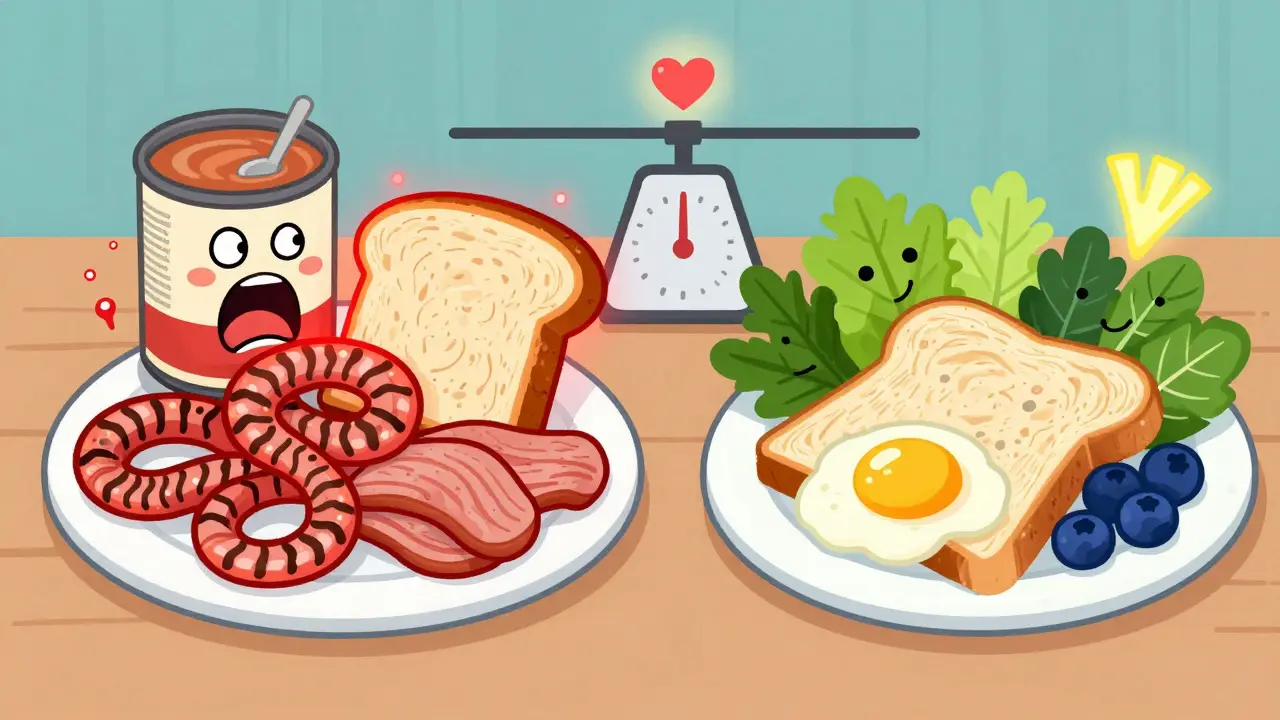
Your kidneys filter out extra salt from your body. When they're damaged, that salt sticks around. The result? Fluid builds up, your blood pressure climbs, and your heart works harder. The Kidney Disease: Improving Global Outcomes (KDIGO) guidelines recommend limiting sodium to 2,000-2,300 milligrams per day for non-dialysis CKD patients. That’s less than one teaspoon of table salt.Here’s the problem: most of that sodium doesn’t come from the salt shaker. About 75% of sodium intake comes from processed and packaged foods. A single serving of canned soup can have 800-1,200 mg. Frozen meals, deli meats, pickles, soy sauce, and even bread are loaded with hidden salt. Reading labels isn’t optional-it’s survival.
Instead of salt, use herbs and spice blends like Mrs. Dash, garlic powder, lemon zest, or black pepper. Cooking at home gives you full control. A 2022 study from the CDC found that cutting sodium by just 1,000 mg per day can lower systolic blood pressure by 5-6 mmHg in CKD patients. That’s the same drop you might get from a low-dose blood pressure pill.
Managing Potassium: The Silent Threat
Potassium helps your muscles and nerves work. But when your kidneys can’t remove it, levels rise. Above 5.5 mEq/L, it can trigger dangerous heart rhythms. That’s why National Kidney Foundation recommends keeping daily potassium under 2,000-3,000 mg for stages 3-5 CKD, depending on blood test results.Not all foods are equal. Fruits and vegetables are healthy-but some are potassium bombs. Bananas (422 mg each), oranges (237 mg each), potatoes (610 mg per medium), and spinach (840 mg per cooked cup) need to be limited. The trick is choosing lower-potassium options: apples (150 mg), berries (65 mg per ½ cup blueberries), cabbage (12 mg per ½ cup cooked), and green beans (175 mg per cup).
There’s a clever trick called leaching. For high-potassium veggies like potatoes or carrots, peel them, slice thin, soak in warm water for 2-4 hours, then boil in plenty of water. This can cut potassium by half. DaVita’s 2023 nutrition guide confirms this method works. Also, remember: potassium from animal foods (meat, dairy) is absorbed more fully than from plants. So even if a food seems low in potassium, how it’s processed matters.
Phosphorus: The Hidden Problem in Processed Foods
Phosphorus is everywhere-your bones, your cells, your energy. But when kidneys fail, phosphorus builds up. High levels pull calcium out of your bones, weaken them, and cause dangerous calcification in your blood vessels and heart.Here’s the critical point: not all phosphorus is the same. Natural phosphorus in foods like chicken, milk, or beans is only 50-70% absorbed. But inorganic phosphorus additives-used in processed foods to preserve, flavor, or color-get absorbed at 90-100%. That’s why a slice of processed cheese (250 mg) or a 12-oz cola (450 mg) is worse than a 3-oz chicken breast (170 mg).
The KDOQI guidelines say non-dialysis CKD patients should aim for 800-1,000 mg daily. Avoid colas, packaged snacks, instant soups, and processed meats. Choose fresh or frozen meats over deli varieties. Swap white bread (60 mg phosphorus per slice) for whole grain (150 mg). Dairy is tricky-milk has 125 mg per ½ cup, but hard cheeses like cheddar pack 130 mg per ounce. Portion control is key.
Protein: The Balance Between Too Much and Too Little
For years, doctors told CKD patients to cut protein hard. But research has shifted. A 2022 study in the Journal of Renal Nutrition found that too little protein (<0.6g/kg/day) increased malnutrition risk by 34% in older adults with CKD.Now, the KDOQI guidelines recommend 0.55-0.8 grams of high-quality protein per kilogram of body weight. That means a 150-pound person needs about 40-60 grams daily. Good sources: eggs, fish (salmon, cod, halibut), chicken breast, and lean beef. Portion size matters-stick to 2-3 ounces per meal, about the size of a deck of cards. Fish is great: low in sodium, moderate in potassium and phosphorus. Eat it 2-3 times a week.
Fluids, Labels, and Daily Life
Many people on a renal diet also need to limit fluids. If you’re making less than 1 liter of urine per day, you may need to cap intake at 32 ounces (1 liter). That includes water, coffee, tea, soup, ice cream-even ice cubes.Meal planning is overwhelming at first. Most patients take 3-6 months to adjust. The Academy of Nutrition and Dietetics found that 78% of patients struggle most with potassium, not sodium. Why? Because fruits and veggies are supposed to be healthy-and they are. But with CKD, you need to swap, not cut.
Use apps like Kidney Kitchen (downloaded over 250,000 times) to track nutrients. Or keep a food diary for a week and bring it to your dietitian. Small changes add up: choosing apples over oranges, white rice over brown, and unsalted butter over salted.

What’s New in Renal Nutrition
The field is evolving fast. In 2023, the FDA approved the first medical food for CKD, called Keto-1, which delivers essential amino acids without extra phosphorus or potassium. The NIH launched the PRIORITY study in early 2024 to test whether genetic testing can predict how your body handles potassium and phosphorus-leading to truly personalized diets.Researchers are also looking at gut health. A 2023 trial showed that prebiotic fibers like inulin can reduce phosphorus absorption by 15-20%. That’s promising for people who find strict diets hard to follow.
And the economics are clear: Medicare now covers 3-6 sessions per year with a renal dietitian for stage 4 CKD patients. Why? Because delaying dialysis by 6-12 months saves about $12,000 per person annually, according to the American Journal of Managed Care.
Real-Life Adjustments: What Works
- Breakfast: White toast with unsalted butter + 1 scrambled egg + ½ cup blueberries. Skip the orange juice.- Lunch: Grilled chicken breast (3 oz) + steamed green beans + ½ cup white rice. Use lemon and herbs instead of salt.
- Dinner: Baked cod (3 oz) + boiled cauliflower (leached) + ½ cup applesauce.
- Snacks: Rice cakes, unsalted popcorn, or a small apple. Avoid nuts, dried fruit, and chocolate.
Don’t try to do this alone. Work with a registered dietitian who specializes in kidney disease. They’ll help you make a plan that fits your life, not just your labs.
Can I still eat fruits and vegetables on a renal diet?
Yes-but you need to choose wisely. Low-potassium options like apples, berries, cabbage, and green beans are fine. High-potassium ones like bananas, oranges, potatoes, and spinach should be limited. Leaching (soaking and boiling) can cut potassium in half for veggies like potatoes and carrots. Portion control matters more than elimination.
Is salt the only source of sodium I need to worry about?
No. About 75% of sodium comes from processed and packaged foods-things like canned soups, deli meats, frozen dinners, bread, and soy sauce. Even if you don’t add salt, you’re still getting too much. Always check nutrition labels for "sodium" content. Look for products labeled "low sodium" or "no salt added."
Why are phosphorus additives so dangerous?
Phosphorus additives-like those listed as "phos" on labels (calcium phosphate, sodium phosphate)-are almost 100% absorbed by your body. Natural phosphorus in foods like meat or beans is only half absorbed. That means a cola or processed cheese can spike your phosphorus levels more than a steak. Avoid anything with phosphorus additives; they’re in most processed foods.
Can I ever have dairy again?
Yes, but in small amounts. Milk, yogurt, and cheese are high in both phosphorus and potassium. A ½ cup of milk has 125 mg phosphorus. Stick to 1-2 servings per day, and choose lower-phosphorus options like unsweetened almond milk (check labels). Hard cheeses like cheddar have more phosphorus than soft cheeses-so limit those.
How do I know if my diet is working?
Your blood tests will tell you. Your doctor will check your sodium, potassium, phosphorus, and calcium levels every 1-3 months. If your potassium stays under 5.0 mEq/L and phosphorus under 4.5 mg/dL, your diet is working. Weight gain from fluid retention is another sign-gaining more than 2 pounds in a day means you’re likely drinking or eating too much fluid or sodium.
Do I need to limit protein?
Not as much as you might think. Too little protein can lead to muscle loss and weakness. The goal is 0.55-0.8 grams per kilogram of body weight daily. For most people, that’s 40-60 grams. Focus on high-quality sources like eggs, fish, chicken, and lean beef. Avoid processed meats and limit red meat to once or twice a week.
Rachele Tycksen
March 23, 2026 AT 22:50ok but like… i tried the leaching thing for potatoes and it was such a pain. i just eat sweet potatoes instead? they’re kinda lower? or am i delusional? also why does everything taste like cardboard without salt??
Grace Kusta Nasralla
March 24, 2026 AT 07:05the real tragedy isn’t the phosphorus… it’s the quiet surrender of flavor. we’ve been taught that health means austerity. but what if the soul withers on a diet of boiled cabbage and unsalted rice? we mistake survival for living.
Aaron Sims
March 25, 2026 AT 20:35Wait-so the government says 2,000mg sodium… but the FDA-approved 'low-sodium' canned soup has 1,200mg PER CAN??!?!? And you're telling me we're not being poisoned by Big Broth?? Also, who decided potassium is the villain? My grandma ate 7 bananas a day and lived to 94. Coincidence? I think not.
Stephen Alabi
March 27, 2026 AT 06:31It is imperative to underscore that the conflation of dietary phosphorus sources-namely, organic versus inorganic-represents a critical oversight in public health discourse. The absorption kinetics of phosphorus additives, as elucidated by KDOQI, are not merely statistical anomalies but pathophysiological imperatives. To suggest that whole foods are inherently safer is to ignore the bioavailability differential, which is statistically significant at p < 0.001. Furthermore, the recommendation to consume whole grain bread over white bread is empirically unsound, as the phytate content may impede mineral absorption, thereby exacerbating nutritional deficiencies. One must question the evidentiary basis of such guidelines.
Kevin Siewe
March 27, 2026 AT 11:21Hey, I’ve been on this diet for 3 years now. It’s not perfect, but small wins add up. I started by swapping one processed item a week-just one. Now I cook most meals. I use lemon and herbs, and my BP is stable. You don’t have to be perfect. Just keep going. You’re not alone.
Chris Farley
March 29, 2026 AT 07:25Let me get this straight-we’re being told to avoid processed foods because Big Pharma wants us on dialysis? That’s the real agenda. Fresh food is expensive. Salt is cheap. Who benefits when we’re all eating boiled chicken and kale? The food corporations. The system is rigged. And don’t even get me started on the potassium myth. My cousin’s a nephrologist-he says it’s all propaganda.
Jesse Hall
March 29, 2026 AT 16:45Thank you for this. I’ve been scared to even try changing my diet. This made it feel doable. 🙏 One step at a time. You got this.
Donna Fogelsong
March 30, 2026 AT 18:56The sodium guidelines are a distraction. The real issue is the systemic corruption of the food supply chain. Industrial processing introduces phosphorus additives as a deliberate mechanism to accelerate renal decline. It’s not negligence-it’s design. Read the ingredient labels. Look for ‘phosphoric acid’ and ‘sodium phosphate.’ They’re not preservatives. They’re weapons.