When a new drug hits the market, it doesn’t just come with a price tag-it comes with a legal shield. Two types of protection keep generics off shelves long after the drug is approved: patent exclusivity and market exclusivity. They sound similar, but they’re not the same. One comes from the patent office. The other comes from the FDA. And confusing them can cost companies millions-or even delay life-saving generics for years.
Patent Exclusivity: The Legal Right to Block Copycats
Patent exclusivity is what you get when you invent something new. In pharmaceuticals, that usually means a new chemical compound, a unique way to make it, or a new use for an old drug. The U.S. Patent and Trademark Office (USPTO) grants this protection under federal law. It gives the drugmaker the right to stop anyone else from making, selling, or using that invention for 20 years-from the day the patent application was filed.
But here’s the catch: drug development takes forever. On average, it takes 10 to 15 years just to get a drug from the lab to the pharmacy shelf. That means by the time the FDA approves it, you might only have 5 to 10 years of actual patent life left. That’s not enough to recoup the $2.3 billion it typically costs to bring a new drug to market.
That’s why patent extensions exist. The law lets drugmakers apply for Patent Term Extension (PTE) to make up for time lost during FDA review. The max extension is 5 years, and the total protected time after approval can’t go beyond 14 years. So if a drug gets approved 12 years after the patent was filed, it might get 2 years of extension-giving it 14 years of market protection from approval.
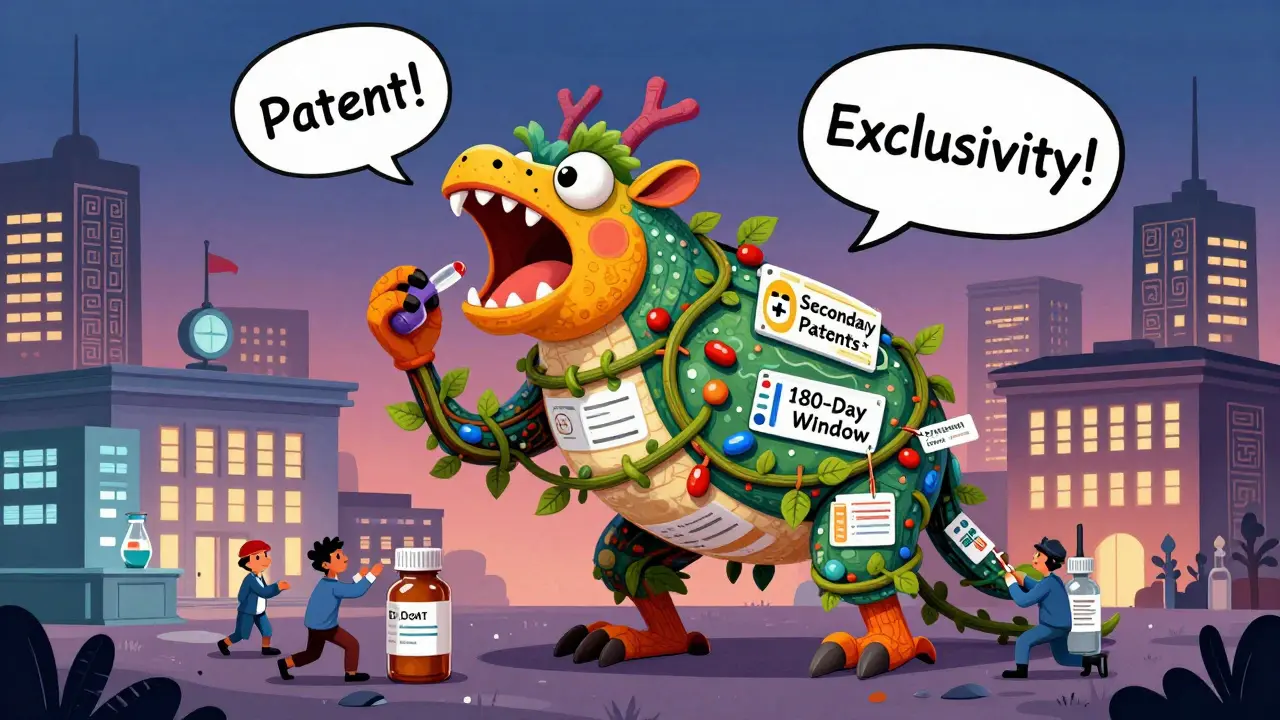
But patents aren’t automatic shields. They need to be enforced in court. If a generic company says your patent is invalid, they can challenge it. That’s why big pharma often files multiple patents-on the pill’s shape, its coating, how it’s taken, even the way it’s packaged. These are called secondary patents. The FTC found that 68% of patents listed in the FDA’s Orange Book are secondary, not the original compound patent. That’s a strategy to stretch protection, sometimes called evergreening.
Market Exclusivity: The FDA’s Approval Lock
Market exclusivity has nothing to do with patents. It’s a regulatory gift from the FDA. It’s not about invention-it’s about data. If you spend years running clinical trials to prove your drug is safe and effective, the FDA won’t let another company copy your data to get their version approved. That’s the core of market exclusivity.
There are different types, each with different rules:
- New Chemical Entity (NCE) exclusivity: 5 years. During this time, the FDA can’t even accept an application from a generic maker. After 4 years, they can file-but they can’t get approval until the 5-year mark.
- Orphan drug exclusivity: 7 years. For drugs treating rare diseases (under 200,000 U.S. patients). This one doesn’t care if there’s a patent. Even if the drug is old, if it’s used for a new rare condition, it gets 7 years.
- Pediatric exclusivity: 6 months added to existing exclusivity. If a company runs extra studies on how the drug affects kids, the FDA rewards them with half a year of extra protection.
- Biologics exclusivity: 12 years. This applies to complex drugs made from living cells-like Humira or Enbrel. Unlike small-molecule drugs, biosimilars can’t rely on the original’s data for 12 years.
- 180-day exclusivity: This one goes to the first generic company that successfully challenges a patent. They get a head start on the market before other generics can enter. That 180-day window can be worth hundreds of millions in extra sales.
Unlike patents, market exclusivity is automatic-if you qualify. The FDA enforces it. No lawsuits needed. If a generic company tries to file an application during exclusivity, the FDA just rejects it. No questions asked.
When They Overlap-and When They Don’t
Here’s where things get messy. A drug can have both protections. Or just one. Or none.
According to FDA data from 2021:
- 27.8% of branded drugs had both patent and market exclusivity
- 38.4% had patents only
- 5.2% had market exclusivity only
- 28.6% had neither
That 5.2% is critical. It means some drugs have no patent at all-but still can’t be copied. Take colchicine. It’s been used since ancient Egypt to treat gout. No one owned a patent on it. But in 2010, Mutual Pharmaceutical got NCE exclusivity for a new formulation. For 10 years, no generic could enter-even though the drug was 3,000 years old. The price jumped from 10 cents to $5 per tablet.
That’s market exclusivity in action: protecting the product, not the idea.
On the flip side, a drug can have a patent but no exclusivity. That happens when the company doesn’t file for exclusivity or doesn’t meet the criteria. Maybe they didn’t submit the right clinical data. Or they used data from another drug. In those cases, generics can move in as soon as the patent expires-even if the drug is brand new.
Why This Matters to Patients and Companies
For patients, these protections mean delays in affordable drugs. For companies, they mean billions in revenue-or massive losses if they misread the rules.
Teva Pharmaceuticals learned this the hard way with Trintellix, an antidepressant. The patents expired in 2021. But the FDA still blocked generics because of 3 years of market exclusivity. Teva couldn’t launch until 2024. That 3-year delay cost them an estimated $320 million.
Small biotech firms get tripped up too. A 2022 survey by the Biotechnology Innovation Organization found that 43% of small companies mistakenly thought patent protection meant market exclusivity. They spent millions developing drugs, only to find out their product had no FDA exclusivity-and generics could come in as soon as the patent expired.
And it’s not just about big pharma. The FDA found that between 2018 and 2022, 22% of innovator companies failed to claim all available exclusivity. On average, they left 1.3 years of protection on the table. That’s free money they didn’t even try to get.
What’s Changing in 2024 and Beyond
The system is under pressure. Critics say the current rules let companies stretch monopolies too long. The FDA just launched a new Exclusivity Dashboard in September 2023-publicly showing every exclusivity period for every approved drug. That’s good for transparency. It also means generic companies can plan their entries better.
Meanwhile, Congress is looking at changes. The PREVAIL Act of 2023 proposes cutting biologics exclusivity from 12 to 10 years. The World Trade Organization is debating whether to extend vaccine patent waivers to other drugs. And McKinsey predicts that by 2027, regulatory exclusivity will account for over half of all drug protection time-surpassing patents.
For now, the dual system stays. Patents protect inventions. Market exclusivity protects data. One needs a lawsuit. The other just needs a form. And if you’re trying to bring a drug to market-whether you’re a giant or a startup-you need to understand both.
Real-World Impact: The Numbers Behind the Rules
It’s not theoretical. These protections shape the entire drug economy:
- The average branded drug earns 65% of its lifetime revenue in the first year after approval.
- Pediatric exclusivity has generated $15 billion in extra revenue since 1997.
- The 180-day generic exclusivity window is worth $100 million to $500 million per drug.
- 78% of drugs with regulatory exclusivity but no patent still had no generic competition during the exclusivity period.
- 58% of new drugs approved in 2022 had no composition-of-matter patent-but still had regulatory exclusivity.
These aren’t abstract legal terms. They’re the reason some drugs cost hundreds of dollars a pill-and why others drop to pennies the moment protection ends.
What You Need to Know
If you’re a patient, know this: just because a drug is new doesn’t mean it’s protected by a patent. And just because a patent expired doesn’t mean a generic is available. Look up the FDA’s exclusivity status.
If you’re in pharma-whether you’re developing, manufacturing, or investing-don’t assume patents = market control. File for exclusivity. Track it. Don’t miss deadlines. A single missed form can cost you years of revenue.
And if you’re a generic company? Study the Orange Book. Watch the FDA’s Exclusivity Dashboard. Know when the clock runs out-not just on patents, but on regulatory protection too. The first to file after exclusivity ends doesn’t just get a head start. They get a monopoly for six months.
Are patent exclusivity and market exclusivity the same thing?
No. Patent exclusivity comes from the U.S. Patent Office and protects inventions-like a new chemical compound or formulation. It lasts 20 years from filing, but often only 10-12 years in practice due to development time. Market exclusivity comes from the FDA and protects the approved drug product by blocking competitors from using the innovator’s clinical data. It lasts 5, 7, 12, or 180 days depending on the type and is enforced automatically by the FDA.
Can a drug have market exclusivity without a patent?
Yes. A drug can have market exclusivity even if it’s an old compound with no patent protection. For example, colchicine-a drug used since ancient times-received 10 years of market exclusivity in 2010 after a company submitted new clinical data for a new formulation. The FDA blocked generics during that time, even though no patent existed.
Why does the FDA grant exclusivity if patents already exist?
Patents protect inventions; exclusivity protects data. Even if a drug is patented, competitors might still try to copy the clinical trial data to get approval faster. Exclusivity prevents that. It’s a separate layer of protection designed to reward companies for the cost and risk of running expensive clinical trials. The two systems work together to balance innovation and competition.
How long does it take for a generic drug to enter the market after exclusivity ends?
As soon as exclusivity ends, generic companies can submit applications. But getting approval takes time-usually 6 to 18 months. The first generic company to file after exclusivity ends may get 180 days of exclusive marketing rights, meaning no other generics can enter during that window. That’s why timing matters so much.
What happens if a company misses the deadline to claim exclusivity?
If a company fails to properly claim exclusivity when submitting its drug application, the FDA won’t grant it retroactively. Between 2018 and 2022, 22% of innovator companies missed out on at least one exclusivity period. On average, they lost 1.3 years of protection per drug-potentially costing millions in lost revenue. It’s not automatic-you have to ask for it.
Ben Kono
January 11, 2026 AT 04:36Big Pharma loves this system because it lets them charge $5000 for a pill that costs 2 cents to make
Rinky Tandon
January 13, 2026 AT 02:11Cassie Widders
January 13, 2026 AT 23:15Konika Choudhury
January 14, 2026 AT 15:05They charge 100x more in America just because they can
Wake up people this is theft disguised as IP
Darryl Perry
January 15, 2026 AT 07:34Windie Wilson
January 15, 2026 AT 16:25Someone invents a drug in 2005
It takes 12 years to get approved
Then they get 14 years of protection from approval
That means they have 26 years of monopoly on a drug that was invented before most of us were born
And we call this innovation?
Daniel Pate
January 16, 2026 AT 00:12Alex Fortwengler
January 17, 2026 AT 17:08jordan shiyangeni
January 19, 2026 AT 12:48steve ker
January 20, 2026 AT 00:41George Bridges
January 20, 2026 AT 13:49Faith Wright
January 21, 2026 AT 02:08Rebekah Cobbson
January 21, 2026 AT 15:07Audu ikhlas
January 22, 2026 AT 13:19They charge 100x because they can
Patents are just excuses to steal from poor countries
Wake up world