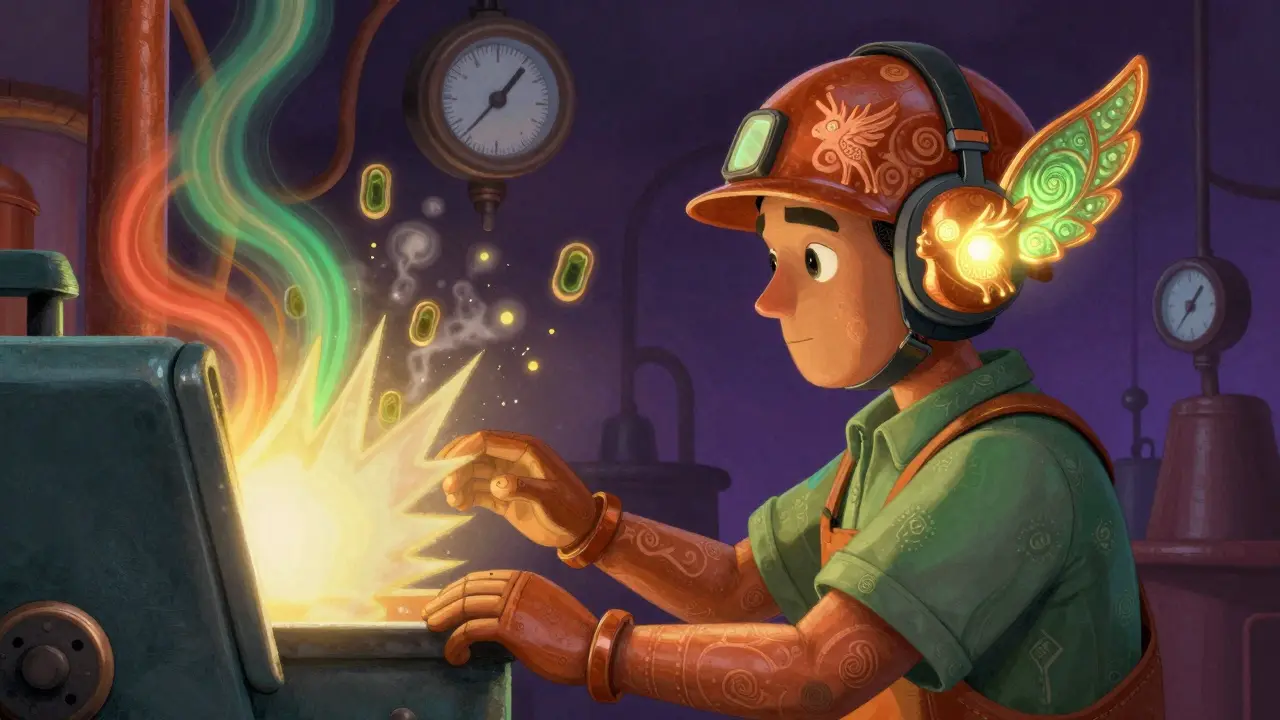
Every year, millions of people lose their hearing-not from aging, not from illness, but from something completely preventable: too much noise. Whether you’re working on a factory floor, using a chainsaw on a weekend project, or standing in front of speakers at a live concert, your ears are taking damage you can’t feel until it’s too late. The good news? We know exactly how much noise is safe. The bad news? Most people don’t follow the rules.
What Counts as Dangerous Noise?
Noise isn’t just loud. It’s about how long you’re exposed and how intense it is. The science is clear: continuous exposure to 85 decibels (dBA) or higher over an 8-hour period puts your hearing at risk. That’s the level of a busy city street, a lawnmower, or a blender running in your kitchen. But here’s the catch: decibels don’t add up linearly. Every 3-decibel increase doubles the noise energy. So at 88 dBA, your safe exposure time drops to 4 hours. At 91 dBA, it’s just 2 hours. At 100 dBA-like a power drill or a motorcycle-you’ve got 15 minutes before you’re in danger. In the U.S., two agencies set different rules. OSHA, the federal workplace safety agency, allows up to 90 dBA for 8 hours. But NIOSH, the research arm that studies actual health effects, says 85 dBA is the real cutoff. Why the difference? OSHA’s rules are legally enforceable but based on what industry can afford. NIOSH’s are based on science: at 85 dBA, only about 8% of workers will develop hearing loss over a lifetime. At 90 dBA? That number jumps to 25%. The European Union and the UK take it even further. The UK’s Control of Noise at Work Regulations set the upper limit at 87 dBA, even after accounting for earplugs. That’s stricter than OSHA and closer to NIOSH’s standard. Australia and China also follow the 85 dBA guideline. When it comes to protecting your hearing, the most protective standards are the ones you should trust.How Noise Damages Your Ears
Your inner ear is packed with tiny hair cells that turn sound waves into electrical signals your brain understands. These cells don’t grow back. Once they’re damaged by loud noise, the hearing loss is permanent. It doesn’t happen all at once. It sneaks up. You might not notice it until you’re struggling to hear conversations in noisy rooms, or you keep asking people to repeat themselves. Studies show that workers exposed to 85-90 dBA for 20 years show clear signs of hearing loss on audiograms, especially at the 3,000-4,000 Hz range-the frequencies that help you understand speech. Even short bursts of loud noise can cause temporary hearing loss, called a temporary threshold shift. That’s when your hearing feels muffled after a concert. Most people think it’ll bounce back. And it usually does… at first. But repeated exposure leads to permanent damage. Research from the Journal of the American Medical Association Otolaryngology found that 50% of people who experience temporary hearing loss after concerts show signs of lasting damage within a year. And it’s not just workers. Concertgoers are at risk too. A typical rock concert hits 100-110 dBA. That’s a chainsaw at close range. Without protection, you’re exposed to dangerous levels in under 15 minutes. Orchestras aren’t safe either-musicians often face 89-94 dBA during rehearsals and performances. A 2022 survey found that 63% of professional musicians already have some degree of hearing loss.What the Law Requires at Work
If you work in manufacturing, construction, mining, or any noisy industry, your employer has legal obligations. OSHA requires a hearing conservation program when noise hits 85 dBA over 8 hours. That means:- Free hearing tests (audiograms) within 6 months of starting and every year after
- Training on how to use earplugs and earmuffs correctly
- Access to hearing protection that reduces noise by at least 15-30 dB
- Eliminate or substitute-use quieter tools or machines
- Engineering controls-install sound barriers, enclosures, or vibration dampeners
- Administrative controls-rotate workers to limit exposure time
- PPE-earplugs and earmuffs, the last line of defense
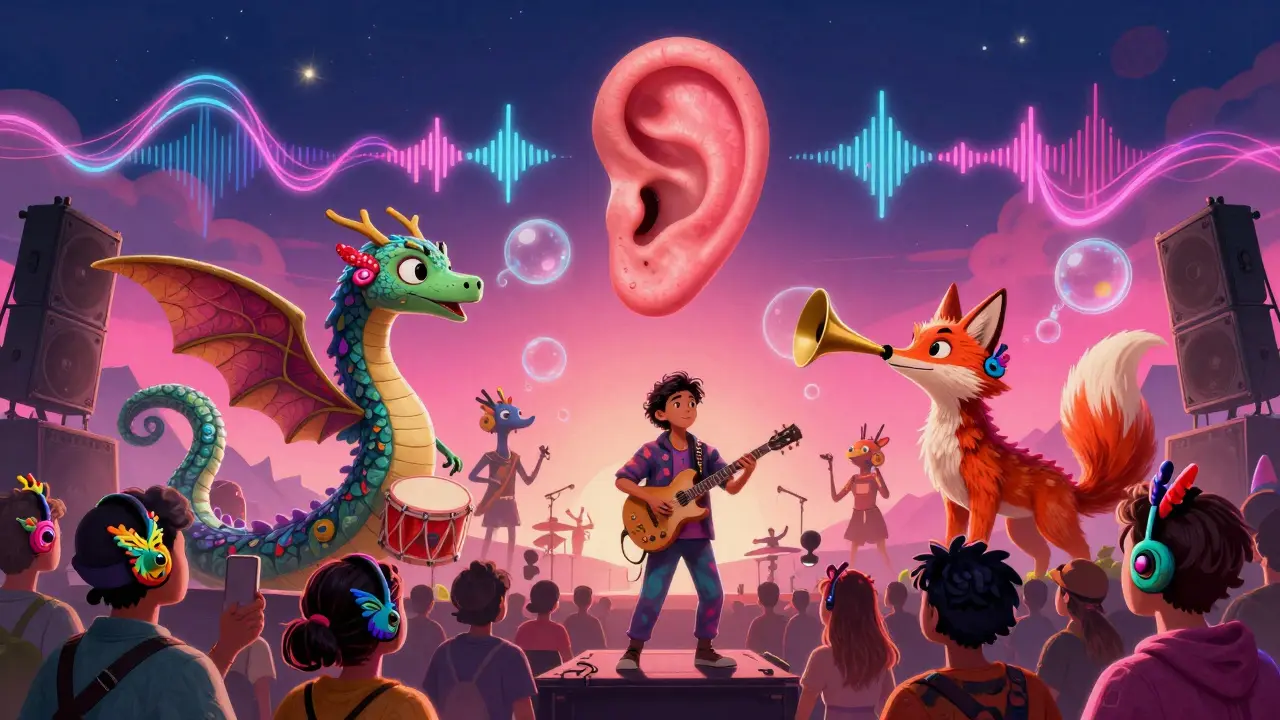
Concerts Aren’t Safe-Even If They Feel Like Fun
No one thinks they’ll go to a concert and come out with hearing damage. But here’s the truth: you don’t need to be a musician to be at risk. A 2023 study found that 30% of concertgoers under 30 showed signs of temporary hearing loss after a single event. And if you go to concerts often? You’re building up permanent damage. Some venues are starting to act. The Lifehouse Festival in the UK gives out free, high-fidelity earplugs-and 75% of attendees take them. Other festivals use “quiet zones” with ambient noise around 70-75 dBA, where you can step away from the music and let your ears recover. Some even display real-time decibel readings on screens so you know when it’s too loud. You don’t need to wait for venues to change. You can protect yourself:- Get high-fidelity earplugs-they reduce volume evenly so music still sounds good
- Stay away from speakers-sound levels drop sharply with distance
- Take 10-minute breaks every hour to give your ears a rest
- Use smartphone apps to measure noise levels-many now track exposure in real time
What Hearing Protection Actually Works
Not all earplugs are created equal. Foam plugs are cheap and widely available, but they need to be rolled tightly and inserted correctly. If you don’t get a good seal, you’re only blocking half the noise. Custom-molded earplugs, made by an audiologist, fit your ear perfectly and offer better comfort for long-term use. Musicians’ earplugs use filters to reduce volume without distorting sound-they’re ideal for concerts and rehearsals. Earmuffs are good for intermittent noise, like using a lawnmower or power tools. But they don’t work well under helmets or with glasses. For constant exposure, earplugs are better. NIOSH says proper hearing protection can reduce noise by 15-30 dB. That means if you’re in a 100 dBA environment and wear plugs that block 20 dB, you’re only exposed to 80 dBA-within the safe range. But if you’re not wearing them right, you’re still getting 95 dBA. Fit matters more than price.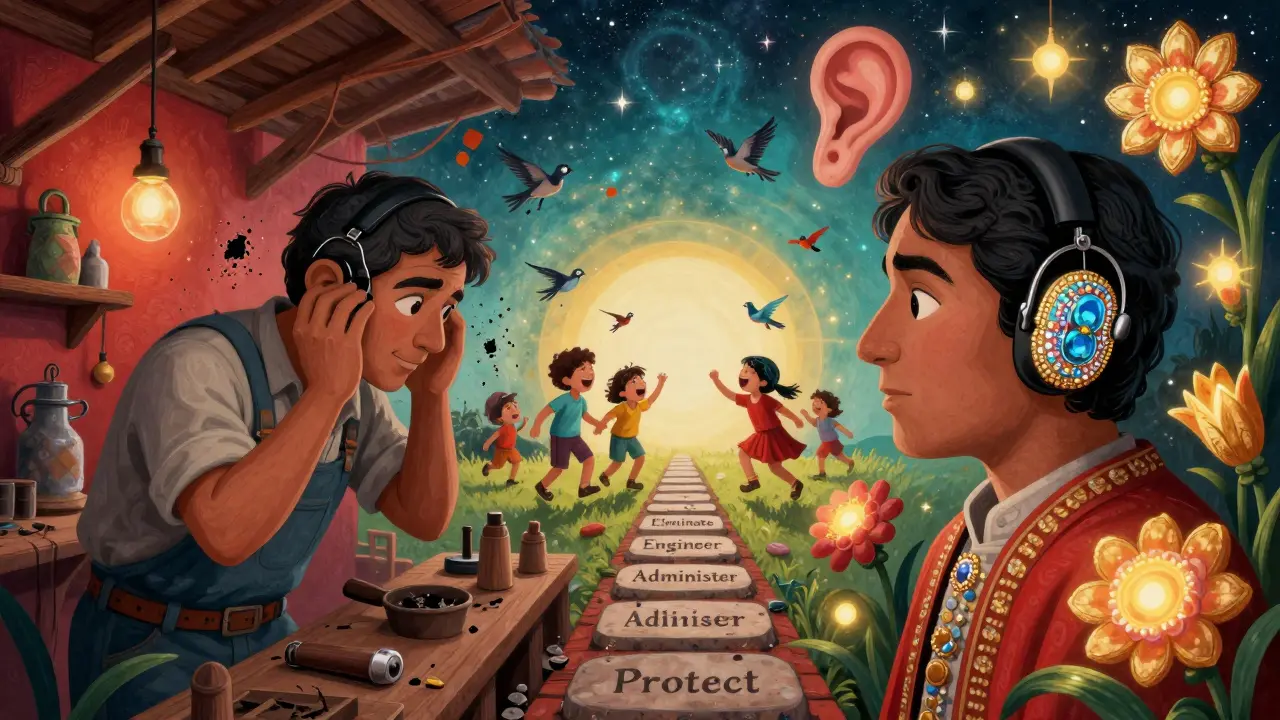
It’s Not Too Late to Protect Your Hearing
Hearing loss is permanent, but it’s also preventable. You don’t have to wait for a doctor to tell you it’s too late. Start today:- If you work in a noisy job, ask your employer for a hearing test-even if you think you’re fine
- Buy a pair of high-fidelity earplugs and keep them in your bag, car, or toolkit
- Turn down your headphones. If someone next to you can hear your music, it’s too loud
- At concerts, move away from speakers and take breaks
- Use a noise-measuring app to check your environment-your phone can be your ear’s best friend
What noise level is considered safe for hearing?
The safest long-term exposure limit is 85 decibels (dBA) averaged over 8 hours. Above that, the risk of permanent hearing loss increases. For every 3-decibel increase, safe exposure time is cut in half. So at 88 dBA, you’re only safe for 4 hours; at 91 dBA, just 2 hours. At 100 dBA, your limit is 15 minutes.
Is OSHA’s noise limit enough to protect my hearing?
No. OSHA allows up to 90 dBA over 8 hours, but this standard is based on economic feasibility, not health. NIOSH, the leading research agency, recommends 85 dBA as the true safe limit. At 90 dBA, about 25% of workers will develop hearing loss over a lifetime. At 85 dBA, that drops to under 8%. Many countries, including the UK and Australia, now follow the stricter NIOSH standard.
Can I use earplugs at concerts without ruining the music?
Yes. High-fidelity or musician’s earplugs use special filters to reduce volume evenly across all frequencies. They don’t muffle sound-they just lower it to a safe level. Many concertgoers report better sound clarity because they’re not overwhelmed by bass or treble spikes. They’re worth the investment if you go to live music often.
How do I know if my hearing is already damaged?
Early signs include ringing in the ears (tinnitus), difficulty understanding speech in noisy places, and feeling like people are mumbling. If you’ve been exposed to loud noise regularly, get a baseline hearing test from an audiologist. It’s quick, painless, and free in many workplaces. Once you know your starting point, you can track changes over time.
Are smartphone apps accurate for measuring noise levels?
Yes. Research published in JAMA Otolaryngology in 2023 found that smartphone noise apps measure environmental sound with 92% accuracy compared to professional sound level meters. Apps like NIOSH’s Sound Level Meter or Decibel X can help you monitor your exposure in real time-whether you’re at work, at a concert, or using power tools.
What should I do if I think my employer isn’t protecting me from noise?
If your workplace exceeds 85 dBA and you’re not offered hearing protection, training, or audiometric testing, you have rights under OSHA. Request a copy of your workplace noise assessment. If none exists, ask for one. You can also file a confidential complaint with OSHA. Employers cannot retaliate against workers for reporting safety concerns.
Can noise-induced hearing loss be reversed?
No. Once the hair cells in your inner ear are damaged, they don’t regenerate. Hearing loss from noise is permanent. But further damage can be stopped. The key is early detection and consistent protection. Even if you’ve already lost some hearing, using protection now can prevent it from getting worse.
Lawver Stanton
December 30, 2025 AT 20:47Look, I get it-noise is bad, blah blah. But come on. I work in construction, and if I wear earplugs every time I use a drill, I can’t hear my foreman yelling at me to move the damn pallet. Plus, those fancy musician plugs cost like $80. I’m not spending that on something I’ll lose in my toolbag. I’ll just turn the volume down on my AirPods when I get home. That’s enough, right?
Also, why do we keep pretending concerts are dangerous? I’ve been to 50 shows and I’m 32. My hearing’s fine. If your ears can’t handle it, maybe you’re just not built for live music. Stop being so fragile.
And don’t even get me started on those apps. My phone says my blender is 95 dB. Yeah, and my coffee’s cold. Who cares?
Just let people live. If I go deaf, I go deaf. At least I had a good time.
Also, my boss gives me earplugs but never trains me. So I just shove ‘em in and forget about ‘em. Works fine. I’m not paying for a seminar on how to roll foam.
And don’t tell me to ‘protect my future self.’ My future self is probably dead anyway from stress or bad tacos. Hearing loss? Minor inconvenience.
Also, I once heard a bird chirp at 7 a.m. and cried. So maybe I’m already gone. 🤷♂️
Sara Stinnett
December 31, 2025 AT 11:33How profoundly disappointing that we’ve reduced public health to a spreadsheet of decibels and compliance thresholds. You speak of ‘safe limits’ as if noise is a mathematical equation rather than a violation of biological integrity.
Let me be clear: 85 dBA is not a ‘limit’-it’s a surrender. It’s the sound of capitalism whispering, ‘We can’t afford to protect you, so here’s a plastic plug and a pat on the head.’
NIOSH’s science is not a recommendation-it’s a moral imperative. Yet OSHA, the very agency meant to safeguard workers, operates as a corporate lobbyist in a hard hat. The 25% lifetime hearing loss rate at 90 dBA? That’s not a statistic-it’s a genocide of the senses, quietly administered by HR departments who’d rather cut costs than conscience.
And don’t you dare call earplugs ‘the last line of defense.’ That’s not hierarchy-it’s a confession of defeat. The real crime isn’t the noise-it’s the normalization of degradation. We don’t let people work in toxic fumes without ventilation. Why do we tolerate sonic torture as ‘just part of the job’?
As for concertgoers-you think it’s ‘fun’ to have your cochlea shredded? That’s not culture-it’s self-abuse masquerading as rebellion. The fact that 30% of under-30s leave concerts with temporary threshold shifts means we’re breeding a generation of deaf artists who’ll never hear their own music again.
And yet, we applaud the Lifehouse Festival for giving out earplugs like it’s charity. It’s not charity-it’s damage control. The real revolution? Ban amplified sound above 85 dBA in public venues unless you’re in a soundproofed chamber. That’s justice. Not plastic plugs. Not apps. Not ‘awareness.’
Until then, we’re not protecting hearing. We’re just teaching people how to die quietly.
Emma Hooper
January 1, 2026 AT 23:17Okay but real talk-I got my first pair of musician earplugs last year after a Metallica show and I swear my ears feel like they’ve been on vacation. The music still sounds amazing, just… balanced. No more ringing for three days. 🙌
Also, I work in a warehouse and we got those fancy earmuffs with Bluetooth. You can hear safety announcements but still block the forklift noise. Game changer.
And for real-try the NIOSH app. It’s free. I checked my vacuum cleaner. 87 dB. Whoa. I didn’t even realize I was standing that close. Now I step back. Small win.
Also, my cousin’s a drummer and he’s got tinnitus. He says the worst part isn’t the ringing-it’s missing his kid’s first words. So yeah. Just… wear the plugs. Even if you think you’re fine. You’re not. I used to think that too.
PS: My dad’s a welder. He’s 68 and still hears the birds. He’s had hearing tests since he was 25. He’s the reason I’m writing this. ❤️
Martin Viau
January 3, 2026 AT 15:40As a Canadian, I find it laughable that the U.S. still clings to OSHA’s 90 dBA standard. We’ve had the 85 dBA limit since 2005 under CSA Z107.56. Our workers don’t get hearing loss at 2x the rate of Americans because we don’t treat safety like a negotiation with Big Industry.
And don’t get me started on your ‘high-fidelity earplugs’-we’ve had those in Canadian music schools since the 90s. You think this is new? We’ve been doing this better for decades. You’re just catching up.
Also, your ‘noise apps’? We’ve had calibrated smartphone sensors in our OHS training since 2018. You’re using tech from 2020 like it’s revolutionary. Meanwhile, in Alberta, they’re rolling out AI-powered real-time noise mapping in mines. You’re still arguing about foam plugs.
Stop pretending you’re innovating. You’re just lagging. And no, I don’t care if you think Canadians are ‘too strict.’ We don’t bury our workers in deafness and call it ‘freedom.’
Robb Rice
January 4, 2026 AT 14:56Thank you for this well-researched and necessary post. The data on NIOSH vs. OSHA is particularly compelling, and the distinction between engineering controls and PPE is critical. I’ve worked in industrial safety for 14 years, and I can confirm: the most effective programs integrate all four tiers of the hierarchy. Too often, companies treat earplugs as a cure-all, when the real solution lies in quieter machinery and job rotation.
I do have one minor correction: in the section on concert exposure, the text states ‘100-110 dBA’-but it should note that peak levels can exceed 120 dBA during drum solos or pyrotechnics. That’s a critical nuance.
Also, I appreciate the mention of smartphone apps. I’ve recommended Decibel X to my team. Accuracy is within ±2 dB when calibrated properly. A small tool with massive impact.
Finally-your closing line about hearing your grandchild? That’s not just emotional. It’s the core of occupational health. We’re not just preserving hearing. We’re preserving connection.
Thank you again. This is the kind of content that changes behavior.
Harriet Hollingsworth
January 5, 2026 AT 09:31People are just lazy. That’s it. No one wants to put in earplugs. No one wants to take a break. No one wants to turn down their music. So now we have to lecture them like children? Grow up.
If you can’t handle loud noise, don’t go to concerts. Don’t work in construction. Don’t use power tools. Simple. Don’t make the rest of us feel guilty because you can’t be responsible for your own ears.
Also, why is everyone acting like 85 dB is some magical number? My neighbor’s dog barks at 90 dB. Should we shut down the neighborhood? No. We live with noise. That’s life.
And stop calling it ‘hearing loss.’ It’s just aging. Everyone gets it. You’re not special. You’re just whiny.
Also, I’ve never used earplugs. I’m 45. I hear fine. So maybe you’re the problem, not the noise.
And for the love of God, stop telling people to ‘protect their future self.’ Your future self doesn’t care. Your present self just wants to have fun.
Stop the fear-mongering. It’s just noise.
Bennett Ryynanen
January 7, 2026 AT 05:33Y’all need to stop overthinking this. I’m a welder. I’ve been around 100+ dB for 18 years. I wear earplugs. Not because I’m scared. Because I’m smart. And I’m tired of people acting like this is some deep philosophical dilemma.
It’s not. It’s simple: if it’s loud enough to hurt your ears, it’s loud enough to damage them. Period.
I bought a pair of custom plugs for $120. They last 5 years. That’s less than $25 a year. Less than your monthly coffee habit.
I also use the NIOSH app. I checked my garage last weekend-my impact wrench hits 105 dB. So I put the plugs in. Done.
And yeah, I go to metal shows. I sit 15 feet back. I take 10-minute breaks. I don’t need a lecture. I just need to not go deaf.
So if you’re reading this and you think you’re fine? You’re not. You’re just not listening. And I’m not being dramatic. I’ve seen coworkers lose their hearing. It’s not glamorous. It’s lonely.
Do the thing. It’s not hard. Just wear the damn plugs.
Chandreson Chandreas
January 8, 2026 AT 22:20Bro, I’ve been a sound engineer in Mumbai for 12 years. I’ve seen musicians go deaf by 35. I’ve seen kids at festivals with earplugs shaped like unicorns 😅
But here’s the truth: the problem isn’t just noise. It’s silence. We’ve forgotten how to listen. We turn up the volume because we’re numb.
My grandma used to say: ‘The loudest things are the ones you don’t hear until they’re gone.’
So yeah-wear plugs. Move away. Use apps. But also… sit still sometimes. Listen to rain. To birds. To your own breath.
That’s the real protection.
And hey-if you’re reading this, you’re already one step ahead. 🙏🎧