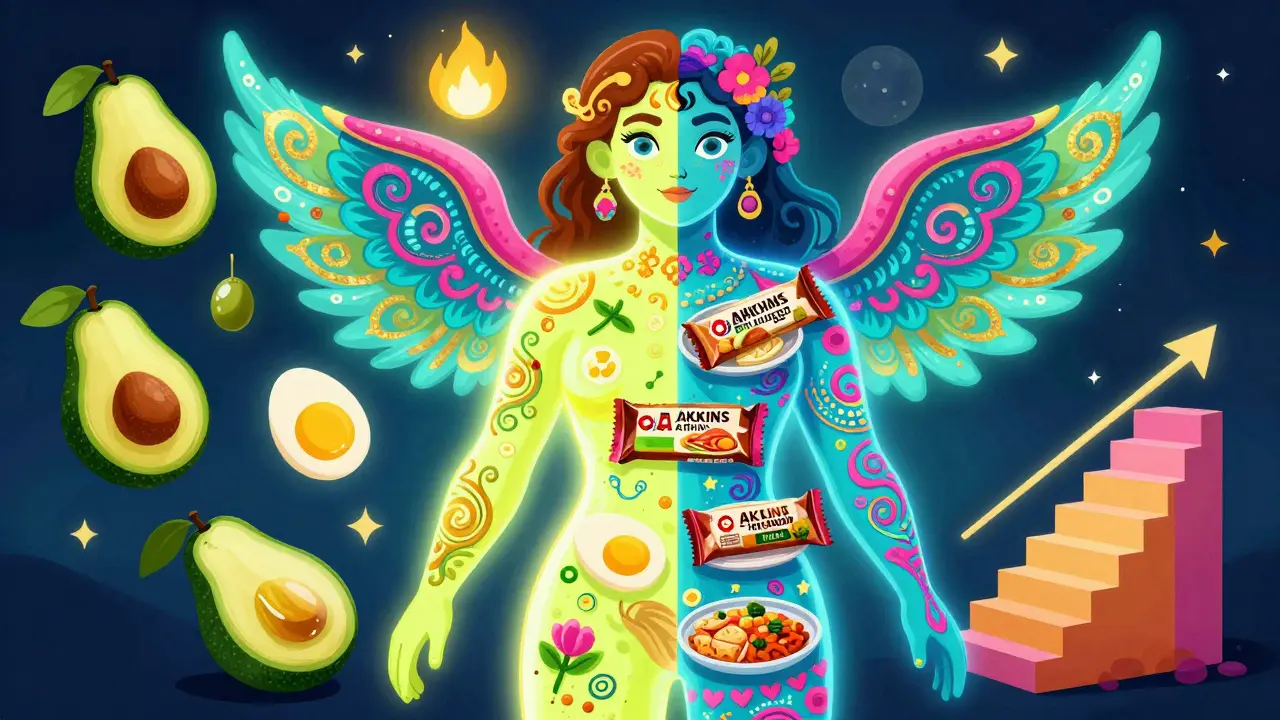
When it comes to losing weight, few diets have sparked as much debate as the ketogenic diet and the Atkins diet. Both promise fast results by cutting carbs, but they’re not the same. If you’re trying to decide which one fits your life, you need to know how they really work - not just the hype.
How Keto and Atkins Actually Work
The ketogenic diet was created in the 1920s to treat epilepsy, not weight loss. It forces your body into ketosis - a state where it burns fat instead of sugar for fuel. To do that, you need to eat about 75-90% of your calories from fat, 15-20% from protein, and only 5-10% from carbs. That usually means under 50 grams of carbs a day. No guesswork. You’re either in ketosis or you’re not. Atkins, on the other hand, was built for weight loss from the start. Dr. Robert Atkins designed it as a four-phase system. Phase 1 (Induction) starts with just 20-25 grams of net carbs a day - similar to keto. But here’s the difference: after two weeks, you slowly add carbs back in. Phase 2 lets you have 25-50 grams. Phase 3 goes up to 50-80 grams. And Phase 4? You can eat up to 100 grams of net carbs daily and still stay at your goal weight. It’s not about staying in ketosis forever - it’s about finding your personal carb tolerance.Protein: The Hidden Difference
Keto is strict about protein. Too much, and your body turns it into glucose through a process called gluconeogenesis. That can kick you out of ketosis. So while you’re eating lots of fat, you’re also watching your chicken breasts and eggs carefully. Atkins doesn’t have that rule. Protein is your friend. You can eat lean meats, fish, eggs, and dairy without worrying about hitting a limit. That’s why many people find Atkins easier to stick with - you don’t need to micromanage every gram of protein.Food Rules: Whole Foods vs. Packaged Snacks
If you’re on keto, you’re expected to eat real food: avocados, eggs, fatty fish, leafy greens, nuts, olive oil. Processed stuff is discouraged. Even sugar-free keto bars are often seen as a last resort. Atkins? It has its own line of snacks. Protein bars, shakes, frozen meals - all labeled “Atkins-friendly.” They’re convenient, especially if you’re busy. But they’re also highly processed. Some people love the ease. Others feel guilty eating them. The diet doesn’t judge - it just gives you the option.What Happens in the First Few Weeks
Both diets cause the same initial shock to your body. When you cut carbs, your body burns through glycogen stores. That means you lose water weight fast - sometimes 5-10 pounds in the first week. It’s not fat, but it feels like progress. Then comes the keto flu. Headaches, fatigue, brain fog, irritability. It hits 70-80% of people on keto. It lasts about two weeks. Your body is switching fuel sources. On Atkins, the same thing can happen during Phase 1, but because the carb increase starts so early, many people feel better sooner.
Long-Term Results: Do They Last?
Short-term? Both work. A 2014 study showed people on keto lost an average of 44 pounds in a year. A 2013 study on Atkins showed weight loss and improved blood sugar in people with type 2 diabetes. But here’s the catch: after 12 months, the difference disappears. Studies from the Mayo Clinic and Harvard show low-carb diets like these aren’t better than other diets for long-term weight loss. People who stick with either plan lose weight - but so do people on balanced, calorie-controlled diets. The real difference isn’t in the scale. It’s in sustainability. A 2023 survey found that 48% of Atkins dieters were still following their plan after a year. Only 35% of keto dieters were. Why? Because Atkins lets you eat more carbs over time. Keto doesn’t. One feels like a temporary fix. The other feels like a lifestyle adjustment.Who It Works For
If you’re young, tech-savvy, and want fast results, keto might appeal to you. It’s popular with people under 35 who track macros with apps like Carb Manager or KetoDiet. You’re okay with strict rules. You like data. You’re willing to test ketones with blood strips that cost $40-60 a month. If you’re older, prefer structure, or don’t want to count every gram of fat, Atkins is the quieter winner. The phased approach gives you milestones. You get to celebrate moving from Phase 1 to Phase 2. You don’t have to stay in starvation mode forever. It’s designed for people who want to eat normally again - just smarter.Expert Opinions and Warnings
Harvard nutrition experts say keto can produce impressive results, but the extreme restriction makes it hard to keep up. Dr. Walter Willett notes that Atkins’ phased model offers a more realistic path to long-term weight management. But there’s a dark side. High saturated fat intake - common in both diets if you’re eating bacon, butter, and cheese all day - can raise LDL cholesterol. Dr. Neal Barnard from the Physicians Committee for Responsible Medicine warns this might increase heart disease risk over time. The American Diabetes Association says low-carb diets help with blood sugar control in the short term. But they also say we don’t have enough long-term safety data. That’s why many dietitians recommend combining either diet with plenty of non-starchy vegetables, healthy fats like olive oil and avocado, and lean protein - not just meat and cheese.
Real People, Real Experiences
On Reddit, keto users say things like, “I lost 50 pounds in 6 months and my blood sugar normalized.” But they also say, “The keto flu nearly broke me.” Atkins users say, “I could finally eat berries again in Phase 3 and still lose weight.” But others admit, “I hit a plateau when I added more carbs - I didn’t know how to adjust.” Trustpilot reviews show Atkins products get 3.8 out of 5 stars. People like the convenience but hate the processed ingredients. Keto brands like Perfect Keto get 4.2 out of 5 - higher satisfaction, but higher cost.What to Do Next
If you’re serious about trying one of these diets:- Start with a 2-week trial of either Phase 1 (Atkins) or standard keto (under 50g carbs).
- Track how you feel - energy, sleep, cravings, mood.
- Don’t buy into the hype of “magic fat-burning.” Weight loss still comes down to calories and consistency.
- Get blood work done before and after. Check cholesterol, liver enzymes, and fasting glucose.
- Don’t go it alone. Talk to a dietitian who understands low-carb diets. They can help you avoid nutrient gaps.
Angela Stanton
January 9, 2026 AT 06:00Okay but let’s be real - keto isn’t a diet, it’s a full-time job. 📊 You’re tracking macros like you’re running a hedge fund. I lost 30 lbs in 4 months, but my social life? Dead. 🥵 No more pizza nights, no more birthday cake, just ketone strips and guilt. At least Atkins lets you ease into normalcy. Also, why are we pretending processed keto bars aren’t just candy with a fancy label? 😒
Johanna Baxter
January 10, 2026 AT 03:13Y’all are overcomplicating this. I did keto for 3 weeks and cried into my avocado. Then I tried Atkins and ate a strawberry. I didn’t die. I didn’t gain weight back. I just felt human again. Why are we treating food like a math problem? 🤡
Kiruthiga Udayakumar
January 11, 2026 AT 02:39People in India have been eating low-carb for centuries - rice is a luxury, not a staple. You think keto is new? We’ve been eating dal, ghee, and greens while you were eating Wonder Bread. This isn’t a trend - it’s ancestral wisdom. Stop treating it like a Silicon Valley startup. 🇮🇳
tali murah
January 11, 2026 AT 03:18Let me just say - if you’re still debating keto vs. Atkins in 2024, you’re probably the same person who thinks ‘intermittent fasting’ is a diet and not just ‘eating less’. The real issue isn’t carb limits - it’s that you’re addicted to the dopamine hit of sugar and you’re looking for a magic bullet. Spoiler: there isn’t one. 🧠
Jenci Spradlin
January 11, 2026 AT 22:37yo i did keto for 6 mos and lost 45 lbs but my liver enzymes went nuts. doc said i was fine but i was so tired i couldnt even walk my dog. switched to atkins phase 3 and now i eat chicken, broccoli, and the occasional sweet potato. no more ketostix. no more panic. just… life. also, dont trust those ‘keto friendly’ snacks. they got more chemicals than my phone.
Ashley Kronenwetter
January 12, 2026 AT 04:34While I appreciate the comparative analysis presented here, I must emphasize the importance of individual metabolic variability. The assumption that either diet can be universally recommended without baseline biomarker assessment is clinically unsound. Nutritional interventions should be personalized, not commodified into viral trends. I urge readers to consult a registered dietitian before embarking on any restrictive regimen.
Aron Veldhuizen
January 14, 2026 AT 03:27Both diets are capitalist traps designed to sell you protein bars and blood ketone meters. The real solution? Eat food. Not macros. Not phases. Not apps. Just meat, veggies, fat, and stop treating your body like a lab rat in a corporate-funded study. We’ve been lied to about calories. We’ve been lied to about carbs. We’ve been lied to about ‘fat is bad.’ But nobody tells you the truth: the only thing that matters is not being hungry. And if you’re hungry, you’re not eating enough fat. Or you’re eating too much bullshit.
Heather Wilson
January 15, 2026 AT 18:46It’s fascinating how the same people who scream ‘biohacking!’ and ‘optimize your mitochondria!’ when talking about keto turn around and buy Atkins frozen meals with 12 ingredients they can’t pronounce. The cognitive dissonance is almost poetic. You want to be a bio-purist? Then stop eating ‘keto chocolate’ made with maltitol. You’re not healing your body - you’re just replacing one addiction with another. And yes, I’ve seen your pantry.
Micheal Murdoch
January 16, 2026 AT 20:05Look - I’ve coached 300+ people through low-carb transitions. The ones who stick with it? They don’t care about ketosis. They care about energy. They care about not feeling bloated after lunch. They care about sleeping through the night. Keto gives you speed. Atkins gives you sustainability. Pick the one that lets you live, not just lose weight. And if you’re still counting grams after 6 months? Maybe the problem isn’t your diet. Maybe it’s your relationship with control.
Jeffrey Hu
January 17, 2026 AT 06:35Actually, gluconeogenesis doesn’t kick you out of ketosis unless you’re consuming >200g protein/day, which most people don’t. You’re misinformed. Also, the 2013 Atkins study had a 7% attrition rate - that’s not a success, that’s a failure. And no, ‘carb tolerance’ isn’t a real thing - it’s just sugar addiction with a fancy name. You’re not ‘finding your carb limit,’ you’re just giving in.
Chris Kauwe
January 18, 2026 AT 15:36Why are Americans so obsessed with ‘diets’? In my country, we just eat. We don’t need phases. We don’t need apps. We don’t need to ‘optimize’ our metabolism. We just eat real food and move. You think your ‘ketogenic lifestyle’ makes you superior? You’re just another privileged person turning food into a religion. Wake up. The planet can’t sustain this obsession with protein bars and blood tests.
Meghan Hammack
January 20, 2026 AT 13:33Y’all are making this so hard. I’m 52, mom of 3, work two jobs. I tried keto. Felt like I was on a hunger strike. Then I tried Atkins Phase 2. I ate eggs, cheese, chicken, and an apple. I lost 20 lbs. I sleep better. I don’t crave sugar. I didn’t buy a single snack. I just ate food. You don’t need to be a scientist to lose weight. You just need to stop eating junk. And maybe… breathe.
RAJAT KD
January 20, 2026 AT 22:38Atkins Phase 4 at 100g net carbs? That’s not low-carb. That’s moderate. You’re just calling it ‘Atkins’ to feel better. The science says any diet under 130g carbs is low-carb. Stop rebranding. And if you’re still losing weight at 80g, congrats - you’re insulin sensitive. Not special. Just lucky.
Matthew Maxwell
January 22, 2026 AT 01:45Anyone who follows these diets without consulting a doctor is playing Russian roulette with their heart. High saturated fat intake = increased LDL = plaque buildup = heart attack. You’re not ‘burning fat,’ you’re clogging your arteries. And no, ‘I feel great’ doesn’t override lipid panels. You’re not a biohacker - you’re a walking risk factor.
Lindsey Wellmann
January 22, 2026 AT 04:09OMG I JUST REALIZED… I’ve been doing keto WRONG 😭 I thought I could eat bacon AND butter AND cheese AND keto brownies AND still be ‘in ketosis’… but my ketone strip said 0.5 and I cried. Then I switched to Atkins and ate a blueberry. And I didn’t die. And I’m still losing weight. And I’m not mad. I’m just… confused. 🥲