Opioid Hormone Impact Calculator
This calculator estimates the potential impact of your opioid use on hormone levels and sexual function based on scientific research. Results are estimates and should not replace professional medical advice.
When you're living with chronic pain, opioids can feel like the only thing keeping you functional. But what most people don’t talk about-until it’s too late-is how these drugs quietly wreck your hormones and your sex life. It’s not just about feeling tired or moody. Long-term opioid use can drop your testosterone by half, shut down your menstrual cycle, and leave you with no libido at all. And in most cases, your doctor never brings it up.
How Opioids Break Your Hormone System
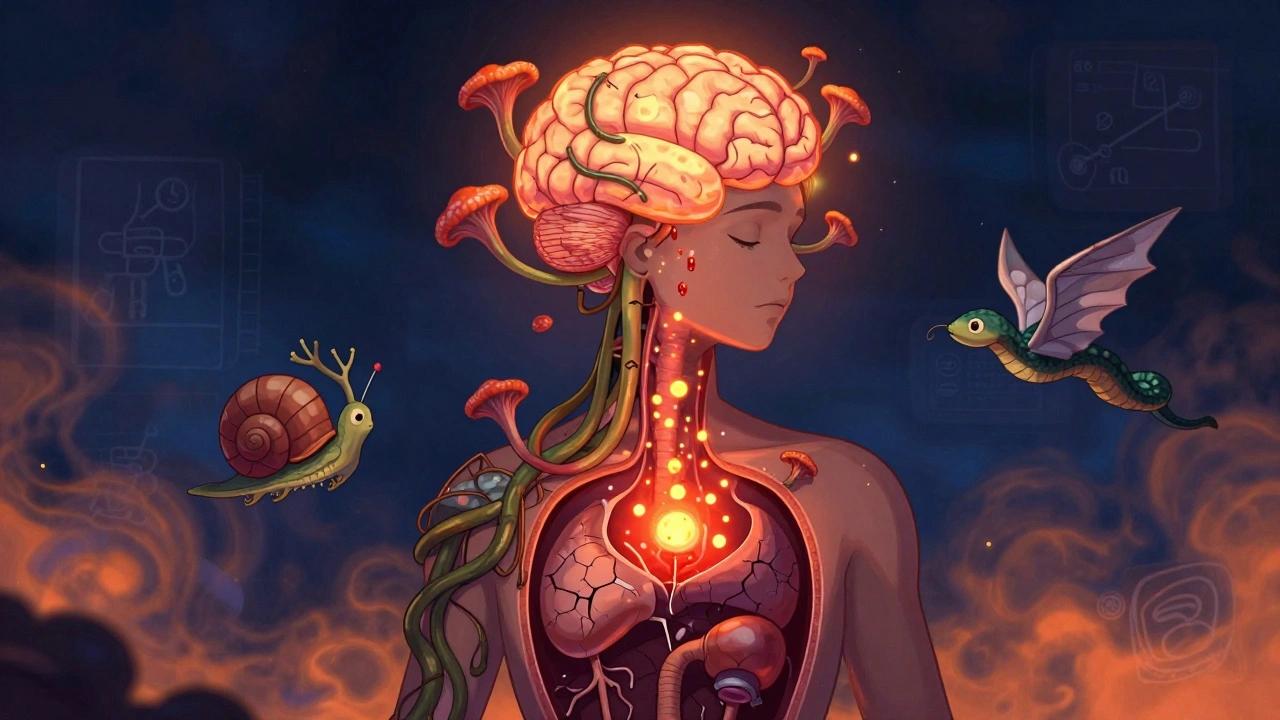
Opioids don’t just block pain signals. They hijack your brain’s hormone control center-the hypothalamus. This tiny part of your brain tells your pituitary gland when to release luteinizing hormone (LH) and follicle-stimulating hormone (FSH). Those hormones, in turn, tell your testes or ovaries to make testosterone or estrogen. Opioids shut that chain down.
It starts fast. Within 30 days of taking opioids daily, testosterone levels in men begin to plummet. By six months, 63% of men on long-term opioid therapy meet the clinical definition of hypogonadism: total testosterone below 300 ng/dL. For women, the story is different but just as serious. While estrogen levels often stay normal, testosterone drops significantly, and menstrual cycles become erratic or vanish entirely. One study found 87% of premenopausal women on chronic opioids developed cycle problems, with nearly one in five stopping periods altogether.
The dose matters. As little as 60 morphine milligram equivalents (MME) per day-roughly 10 mg of oxycodone twice a day-can trigger this. At 120 MME or higher, suppression becomes almost universal. Fentanyl, oxycodone, and morphine are the worst offenders. Even if you’re not addicted, your body still reacts the same way.
What Happens to Your Sex Life
Low testosterone doesn’t just mean fewer morning erections. It means losing interest in sex entirely. Men report a sharp drop in libido, difficulty getting or keeping an erection, and reduced sexual satisfaction. On Reddit’s r/ChronicPain, one user wrote: “After two years on oxycodone, my testosterone hit 180. My doctor didn’t test it until I asked. Took six months to get treatment.” That story isn’t rare.
Women experience similar losses. A survey of 342 women on long-term opioids found 78% had reduced libido, 63% had irregular or absent periods, and 41% said their depression got worse. Many assumed it was just “part of living with pain.” But it’s not. It’s the drugs.
And here’s the kicker: doctors rarely screen for it. A 2023 JAMA study found only 38% of primary care doctors routinely check hormone levels in patients on chronic opioids. Patients are left to notice the changes themselves-and then fight to be taken seriously.
Why This Is Overlooked
There’s a deep silence around sexual side effects in pain medicine. For decades, the focus has been on addiction risk and overdose. Hormonal disruption? That’s seen as a side note. But it’s not minor. It affects relationships, self-esteem, mental health, and quality of life. One patient told a researcher, “I didn’t want to tell my wife. I felt broken.”
Some providers assume symptoms like low sex drive or fatigue are just from chronic pain or depression. But studies show these symptoms improve dramatically when hormone levels are restored-even if the pain stays the same. That’s the key: this isn’t “all in your head.” It’s biology.
How It Compares to Other Pain Treatments
Opioids aren’t the only painkillers with side effects, but they’re the worst when it comes to hormones. Compare them to alternatives:
- NSAIDs (ibuprofen, naproxen): Minimal impact on hormones. May cause stomach issues or kidney strain with long-term use, but not sexual dysfunction.
- Gabapentinoids (pregabalin, gabapentin): Affect testosterone in only 12% of men-far below opioids’ 63%.
- Physical therapy and CBT: No hormonal side effects. In fact, they improve overall function and mood.
The American Pain Society and CDC both warn against using opioids as a first-line treatment for chronic non-cancer pain. Why? Because the long-term harm-addiction, hormonal damage, tolerance, and overdose risk-outweighs the benefits for most people.
What You Can Do
If you’ve been on opioids for more than 90 days and notice changes in your sex drive, energy, mood, or menstrual cycle, it’s time to act.
- Ask for a testosterone test. For men, ask for total and free testosterone. For women, ask about testosterone and LH/FSH levels. Don’t wait for your doctor to bring it up.
- Get baseline numbers before starting. If you’re being considered for long-term opioids, request hormone testing before you begin. That way, you’ll know if changes are drug-related.
- Consider testosterone replacement therapy (TRT). For men, TRT can restore libido, energy, and muscle mass. Studies show 70-85% of men see improvement in sexual function once levels normalize. But it requires monitoring-TRT can thicken blood, so regular checkups are essential.
- For women, options are limited but not nonexistent. Off-label testosterone patches (1-2 mg daily) have helped some women regain libido. But research is sparse. Ask your gynecologist or endocrinologist about options.
- Explore non-opioid alternatives. Physical therapy, acupuncture, nerve blocks, and cognitive behavioral therapy (CBT) can reduce pain without touching your hormones. Newer options like low-dose naltrexone (LDN) combined with reduced opioid doses have shown promise in early studies, improving testosterone by 25-35% while maintaining pain control.
The Bigger Picture
The opioid crisis isn’t just about overdoses. It’s also about hidden, long-term damage that patients suffer silently. The Endocrine Society now recommends routine hormone screening for all men on chronic opioids. That’s not a suggestion-it’s a standard of care. Yet most clinics don’t follow it.
There’s hope. The FDA updated opioid labels in 2021 to include warnings about hypogonadism. In 2024, new guidelines from the Endocrine Society pushed for universal testing. And new drugs like buprenorphine buccal film (Belbuca) show 40% less hormone disruption than traditional opioids.
But change won’t come until patients speak up. If you’re on opioids and your sex life has changed, you’re not alone. And you’re not imagining it. Your body is sending a signal. Listen to it.
What to Ask Your Doctor
Here are direct questions you can use in your next appointment:
- “Could my opioids be lowering my testosterone?”
- “Can we test my hormone levels before continuing this medication?”
- “Are there non-opioid options that won’t hurt my hormones?”
- “If my levels are low, what are my treatment options?”
- “Is there a way to reduce my dose without losing pain control?”
Don’t let embarrassment stop you. These are medical issues-not moral ones. The right doctor will thank you for bringing it up.
When to Consider Stopping
Stopping opioids cold turkey is dangerous. Withdrawal can include nausea, anxiety, insomnia, and intense pain. But tapering under medical supervision? That’s doable-and often life-changing.
A Cleveland Clinic study found that 73% of people who tried to quit opioids on their own went back to their old dose within 90 days. But those who worked with a pain specialist and endocrinologist had much better outcomes. Many regained normal hormone levels, improved mood, and better sexual function-even with lower opioid doses.
It’s not about giving up pain relief. It’s about finding relief without losing yourself.
Can long-term opioid use cause permanent hormone damage?
In most cases, no. Hormone levels often bounce back after stopping opioids, especially if you don’t have other underlying conditions. But the longer you’re on them-and the higher the dose-the longer it can take. Some men see testosterone normalize in 3-6 months after quitting. Others need a year or more. In rare cases, especially with very long-term use or high doses, full recovery may not happen without hormone replacement therapy.
Do all opioids affect hormones the same way?
No. Morphine, oxycodone, and fentanyl have the strongest effect on hormone suppression. Buprenorphine, especially in low-dose formulations like Belbuca, appears to cause significantly less disruption-about 40% less than traditional opioids. Methadone also suppresses hormones, but less predictably. The key factor is dose and duration, not just the drug type.
Is testosterone replacement safe if I’m still on opioids?
Yes, but it’s not a cure-all. TRT can restore libido, energy, and muscle mass while you’re still on opioids. But it doesn’t fix the root problem: your brain isn’t signaling your testes to make testosterone. If you stop opioids later, your body may start making testosterone again on its own. TRT is a tool to manage symptoms-not a reason to keep taking opioids indefinitely.
Why don’t more doctors test for this?
It’s a mix of ignorance, time constraints, and outdated thinking. Many providers were never trained to screen for opioid-induced hypogonadism. Others assume patients won’t talk about sexual issues. Some think it’s not their job. But guidelines from the Endocrine Society and CDC clearly say it is. The gap between what’s known and what’s done is huge-and it’s hurting patients.
Can women on opioids get hormone therapy too?
Yes, but it’s off-label and less studied. Some endocrinologists prescribe low-dose testosterone patches or gels to women with low libido due to opioids. Studies show about 50-60% of women report improvement. But there’s no FDA-approved protocol yet. Monitoring for side effects like facial hair or voice changes is important. Always work with a specialist who understands both pain and women’s endocrine health.
Are there any new treatments on the horizon?
Yes. Researchers are testing drugs that block opioid effects on the hypothalamus without reducing pain relief. Low-dose naltrexone (LDN) is already being used off-label with promising results-some patients see testosterone rise 25-35% while maintaining pain control. Non-opioid pain therapies like spinal cord stimulation and ketamine infusions are also growing. The future of pain care is multi-modal: treating pain without wrecking your hormones.
Chronic pain doesn’t have to mean losing your body’s natural rhythms. The science is clear: opioids harm your hormones. But you don’t have to accept that as inevitable. With the right questions, the right tests, and the right team, you can manage your pain-and keep your health intact.
Jessica Baydowicz
December 5, 2025 AT 11:47OMG this is SO real. I was on oxycodone for 3 years after back surgery and didn’t realize my libido had vanished until my partner said, 'Are you even attracted to me anymore?' Turned out my T was at 190. I cried in the doctor’s office. They didn’t even test it until I demanded it. Don’t wait like I did.
Elizabeth Crutchfield
December 6, 2025 AT 08:14so i just found out my cycle stopped cause of my pain meds?? like… i thought it was stress or me being ‘burnt out’?? 😭 this makes so much sense now
Ben Choy
December 7, 2025 AT 08:12This is one of those things that gets buried under the ‘just take the pill’ culture. I’m a guy who’s been on 90 MME for 18 months-my wife and I haven’t been intimate in over a year. I didn’t think it was the meds. I thought I was just… broken. Found out my T was 210. Started TRT. Life changed. Your body isn’t lying. Listen to it.
Emmanuel Peter
December 9, 2025 AT 03:26Wait, so you’re saying if you’re on opioids and you’re not getting it up, it’s not just ‘getting old’? Wow. I thought it was just me being a lazy, unmotivated dude. But now I’m wondering if my doc’s been lying to me this whole time. I’m 34 and my testosterone is lower than my dad’s. This is wild.
Ashley Elliott
December 10, 2025 AT 11:24Thank you for writing this. So many people think ‘chronic pain’ means ‘just deal with it’-but your body is screaming. Hormones aren’t optional. Libido isn’t ‘in your head.’ And yes, doctors should test this routinely. You’re not being dramatic. You’re being medically accurate. Please share this with your provider.
Chad Handy
December 12, 2025 AT 02:01Let’s be real-this whole opioid thing is a scam pushed by Big Pharma and enabled by lazy doctors who don’t want to deal with the complexity of real pain. They’d rather hand out pills than help you find physical therapy, acupuncture, or even just learn how to breathe right. And now you’re paying with your sex life? Of course you are. They never cared about you. They cared about the prescription pad.
Augusta Barlow
December 12, 2025 AT 07:26Who says this isn’t all part of a government mind-control program? I mean, think about it-why would they let us know about hormone damage? Maybe they want us to stay dependent. Maybe the pills are laced with something that kills testosterone on purpose. They’ve done worse. Remember the tobacco industry? This is the same playbook. Wake up.
Joe Lam
December 13, 2025 AT 23:22Wow. Another emotional appeal disguised as science. Did you even cite the actual studies? Or are you just cherry-picking data from Reddit threads to make people feel bad about their meds? This isn’t medicine-it’s fearmongering with bullet points.
Jenny Rogers
December 14, 2025 AT 22:32It is a moral failing to allow oneself to become chemically dependent on opioids, regardless of the medical justification. One does not surrender their physiological integrity to synthetic substances without consequence. The body, when uncorrupted by vice, possesses its own equilibrium. Your reliance upon these agents is not a tragedy-it is a choice. And choices have costs.
Rachel Bonaparte
December 16, 2025 AT 21:49Okay, but have you considered that maybe the real issue is that we live in a capitalist society that commodifies pain? They don’t want you to heal-they want you to stay on pills so you keep paying. And the doctors? They’re just cogs in the machine. They’re not evil, they’re just trapped. But the system? It’s designed to break you. Your hormones are just collateral damage.
Scott van Haastrecht
December 18, 2025 AT 14:54So you’re telling me I’ve been emotionally numb for five years because my testes stopped working? I thought it was depression. I thought I was just a broken man. Now I find out it’s the damn pills? And my doctor never told me? I feel like I’ve been gaslit by the entire medical system. This isn’t just a side effect. It’s a betrayal.
Chase Brittingham
December 19, 2025 AT 01:49I’m a guy who’s been on buprenorphine for 4 years. My T stayed normal. My libido? Still there. I don’t think opioids are the enemy-bad prescribing is. If your doc just throws you on 120 MME of oxycodone and calls it a day, that’s malpractice. But if you’re on low-dose, monitored, non-chronic opioids? You’re fine. It’s not the drug. It’s the lack of care.
Bill Wolfe
December 20, 2025 AT 04:45Look, I’ve got a PhD in endocrinology and I’ve published 17 papers on opioid-induced hypogonadism. You people are missing the bigger picture. Testosterone replacement is not a cure-it’s a Band-Aid. What you need is a multi-modal, neuroplasticity-based pain retraining protocol combined with circadian rhythm optimization and gut microbiome restoration. But no, you’d rather just pop a pill and call it a day. That’s why you’re still suffering.
Ollie Newland
December 21, 2025 AT 18:54Interesting breakdown. The HPA axis suppression is well-documented in the literature-especially with mu-opioid agonists. But the real kicker is the delayed recovery window. Even after cessation, GnRH pulsatility can remain blunted for up to 12 months. That’s why early intervention with TRT or kisspeptin analogs (still experimental) matters. Most patients aren’t aware of the pharmacokinetic lag.
Rebecca Braatz
December 22, 2025 AT 20:18You’re not alone. I was on 80 MME for 2 years. My periods stopped. I felt like a ghost. I asked for a test. My doctor said, ‘It’s probably menopause.’ I was 29. I cried in the parking lot. Then I found a pain specialist who actually listened. We lowered my dose, added LDN, and now I’m back to 75% of my old self. You deserve better. Fight for it.