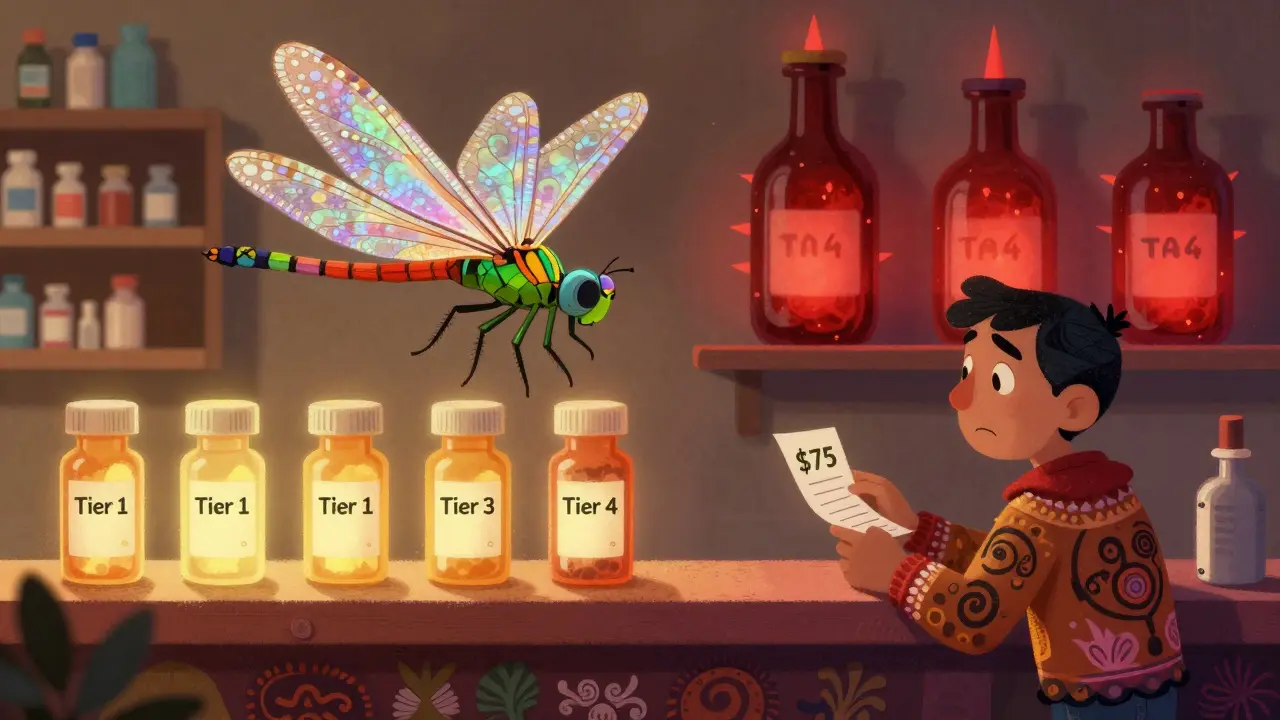
When you get your prescription filled at the pharmacy, have you ever wondered why some drugs cost $10 while others cost $75-even if they treat the same condition? The answer lies in your employer’s health plan and how it uses generic drugs to control costs. Most large employers don’t just offer health insurance-they manage a complex system of drug coverage designed to push you toward cheaper, equally effective options. But without understanding how it works, you could be paying more than you need to-or even losing access to a medication you rely on.
How Employer Prescription Plans Work
Your employer’s health plan doesn’t pay for drugs directly. Instead, it contracts with a Pharmacy Benefit Manager (PBM)-companies like OptumRx, CVS Caremark, or Express Scripts-to handle drug coverage. These PBMs create a list called a formulary, which tells you which medications are covered and at what cost. This isn’t a static list. It changes constantly as new generics hit the market and PBMs negotiate with drugmakers. Formularies are split into tiers. Each tier has a different out-of-pocket cost for you:- Tier 1: Generic drugs. Usually $10 or less per prescription.
- Tier 2: Preferred brand-name drugs. Often $40.
- Tier 3: Non-preferred brand-name drugs. Typically $75.
- Tier 4: Specialty drugs. Can cost hundreds, sometimes over $1,000 per month.
If a brand-name drug becomes available as a generic, the PBM automatically moves the generic to Tier 1 and pushes the brand version to Tier 4. That means if you keep taking the brand-name version, your copay jumps from $40 to $75-or more. This isn’t a random decision. It’s a financial nudge. The system is designed to make the cheaper option the easiest one.
Why Generics Are the Default Choice
The FDA confirms that generic drugs are just as safe and effective as brand-name drugs. They contain the same active ingredients, work the same way, and go through the same approval process. The only real difference? Price. Generics cost 80-85% less because manufacturers don’t have to repeat expensive clinical trials or run national ad campaigns. That’s why, according to the Schauer Group, generic drugs save more than $3 billion every week-over $150 billion a year nationwide. Employers love this. For them, switching employees to generics isn’t just good policy-it’s budget-saving. But here’s the catch: the savings don’t always show up in your wallet.The Hidden Gap Between Savings and What You Pay
PBMs don’t just use formularies to steer you toward generics. They also use them to negotiate rebates from drugmakers. Here’s how it works: a drug’s list price (what it’s sold for) might be $100. But after rebates, discounts, and returns, the PBM’s actual net cost might be $45. That’s a 55% gap-the “gross-to-net” spread. KPMG found that’s the average across the industry. The problem? That $55 difference doesn’t go to you. It goes to the PBM. So even though the drug cost dropped by half, your copay might still be $75. And if the drugmaker refuses to offer a big enough rebate, the PBM might just remove the drug from the formulary entirely. You lose access. No warning. No advance notice. This is why so many people are surprised when their medication suddenly becomes unavailable. It’s not because it’s unsafe. It’s because the business deal changed.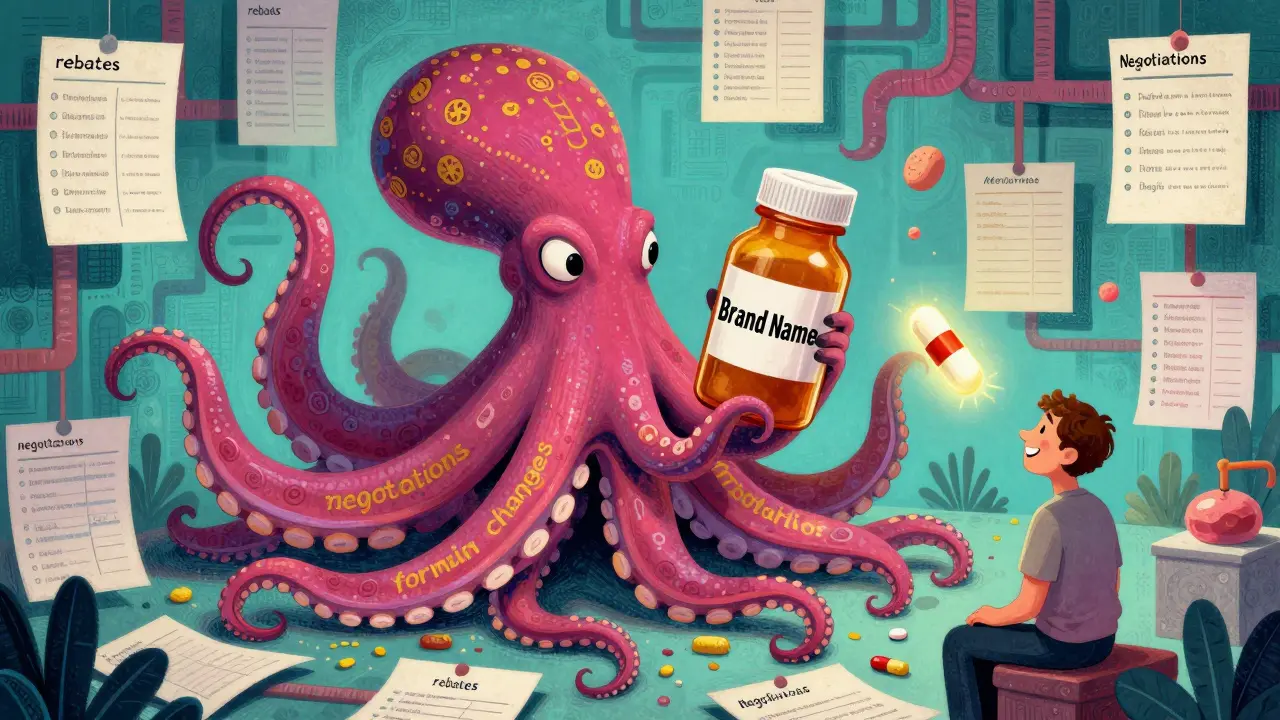
What Happens When Your Drug Gets Removed
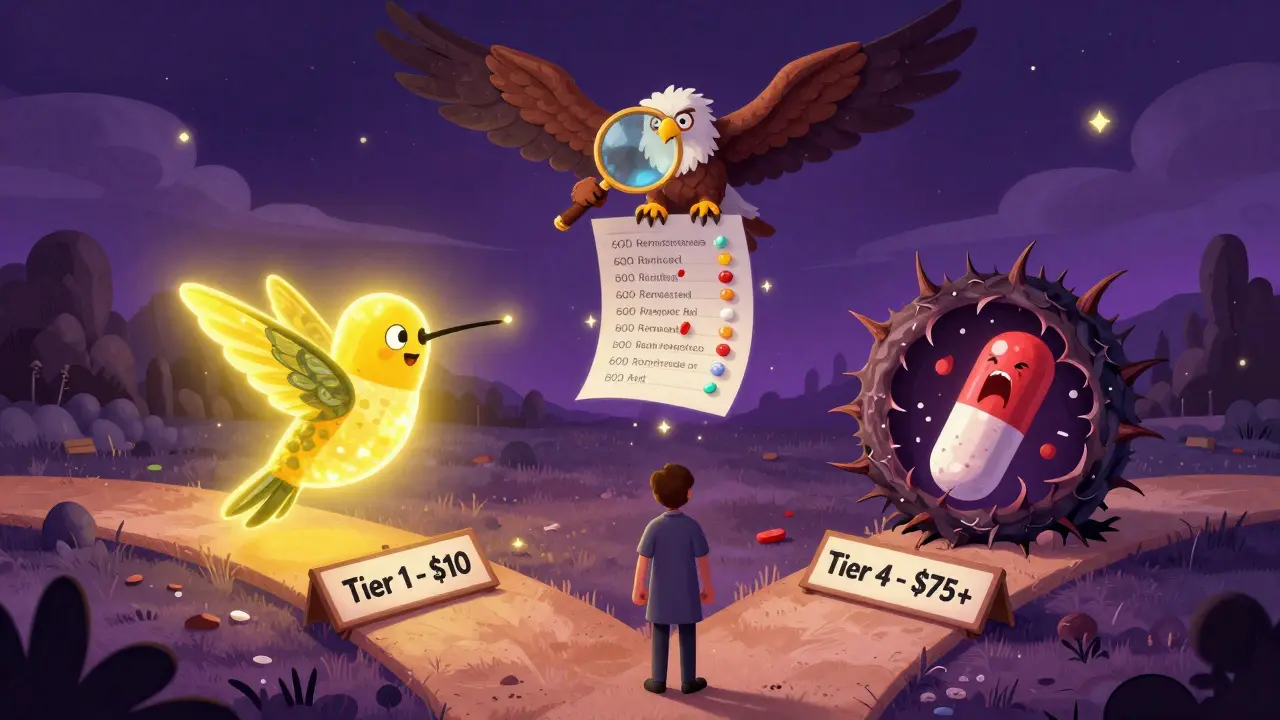
On January 9, 2024, each of the three largest PBMs removed over 600 drugs from their formularies. That’s more than 1,800 drugs gone in one day. These exclusions aren’t mistakes. They’re negotiation tactics. PBMs use them to pressure drugmakers into offering bigger rebates. If your medication is removed, you have two choices:- Switch to a generic or alternative drug on the formulary.
- Ask your doctor to file a medical exception.
Medical exceptions aren’t automatic. Your doctor must prove the drug is medically necessary-for example, if a generic caused side effects or didn’t work. Your employer or insurer will review it. Approval can take days or weeks. In the meantime, you might have to pay full price.
Some employers offer care management programs-like HealthOptions.org’s Chronic Illness Support Program-to help employees find affordable alternatives. These programs assign a care manager who can call pharmacies, check for coupons, or even help you apply for patient assistance programs.
How to Find Out What’s Covered
You can’t rely on memory. Formularies change weekly. Here’s how to stay ahead:- Visit your insurer’s website. Look for “Drug List,” “Formulary,” or “Prescription Coverage.”
- Check your Summary of Benefits and Coverage (SBC). It’s mailed to you or available online.
- Call your insurer. Ask: “Is [drug name] covered? What tier is it on?”
- Use your pharmacy’s app. Many have real-time cost checks before you fill a prescription.
Don’t wait until you’re at the counter. A quick check could save you $65-or prevent a disruption in your treatment.
What Employers Are Doing to Help
Forward-thinking employers are moving beyond just offering coverage. They’re educating employees. Some send out payroll stuffers, emails, or even short videos explaining why generics are safe. Others integrate cost-saving tools into their benefits portals, like automatic discounts on generics through in-network pharmacies.One employer in Ohio started a “Price Assure Program” that locks in lower prices on generics, even if the formulary changes. Another offers a $0 copay on common generics for diabetes and high blood pressure. These aren’t charity-they’re smart business. When employees understand the system, they use generics more, which lowers overall drug spending.
But education only works if you’re listening. If you’ve ever thought, “Generics are cheaper, but they’re not as good,” you’re not alone. But the science doesn’t back that up. The FDA has approved over 10,000 generic drugs. Millions of people take them every day without issue.
What You Can Do Today
Here’s your action plan:- Find your plan’s current drug list. Do it now.
- Check the tier of any medication you take regularly.
- If you’re on a brand-name drug with a high copay, ask your doctor: “Is there a generic version?”
- If your drug was removed from the formulary, contact your employer’s HR or benefits team immediately.
- Sign up for alerts. Many insurers let you get email or text updates when formularies change.
You don’t need to be an expert. You just need to be informed. The system is built to save money-but only if you know how to use it.
Final Reality Check
The truth is, your employer’s health plan isn’t designed to make your life easy. It’s designed to control costs. And generics are the most powerful tool they have. That’s why 99% of large employer plans include prescription coverage-and why nearly all of them prioritize generics.But you’re not powerless. You can still get the care you need. You just have to know where to look, what to ask, and when to act. The savings are real. The system is complex. But with a little effort, you can make sure you’re getting the full benefit-not just the one the plan wants you to see.
Are generic drugs really as good as brand-name drugs?
Yes. The FDA requires generic drugs to have the same active ingredients, strength, dosage form, and route of administration as the brand-name version. They must also meet the same strict manufacturing standards. Studies show generics work just as effectively. The only difference is price-generics are typically 80-85% cheaper because they don’t need to repeat expensive clinical trials or run national ads.
Why does my copay go up even when a generic becomes available?
When a generic becomes available, the PBM moves it to the lowest tier (Tier 1) and moves the brand-name version to the highest tier (Tier 4). This makes the brand-name drug much more expensive for you. It’s not a mistake-it’s intentional. The system is designed to encourage switching to the cheaper option. If you continue with the brand, you pay more.
Can my employer remove my medication without warning?
Yes. Formularies change frequently-sometimes weekly. PBMs remove drugs to pressure manufacturers into offering larger rebates. You might not get advance notice. That’s why checking your drug list regularly is critical. If your medication is removed, contact your employer or insurer right away to request a medical exception or find an alternative.
Why don’t I see the savings from generic drugs in my pocket?
The savings from generics mostly go to your employer and the PBM, not directly to you. PBMs negotiate rebates from drugmakers, but those rebates don’t always lower your copay. In fact, the average gross-to-net spread is 55%, meaning most of the discount stays with the PBM. Your out-of-pocket cost is still based on the formulary tier, not the actual cost of the drug.
What should I do if my medication is no longer covered?
First, check if there’s a generic or alternative drug on the formulary. If not, ask your doctor to file a medical exception. This requires documentation that the drug is medically necessary. You can also contact your employer’s HR or benefits team-they may have a care manager who can help you find lower-cost options, coupons, or patient assistance programs. Don’t stop taking your medication without a plan.
matthew runcie
March 20, 2026 AT 12:14Just checked my formulary today. My blood pressure med switched to Tier 1. $3 copay now. No drama, no fuss. System works if you pay attention.
Also, my pharmacy app flagged a cheaper alternative I didn’t even know about. Took 2 minutes. Saved me $42.
Do the thing. It’s not hard.
Allison Priole
March 21, 2026 AT 11:40okay so i’ve been on this brand name med for 8 years because my doc said it was ‘better’ but like… i just read the fda page and they literally say generics are the same??
why do we still act like brand name is premium? i feel manipulated
switched to generic today. no side effects. no ‘weaker’ feeling. just cheaper. weird.
also my copay went from $78 to $10. i’m crying but not because i’m sad. because i’m mad at myself for not doing this sooner
Casey Tenney
March 22, 2026 AT 03:54You’re being scammed. PBMs are middlemen who pocket billions while you pay $75 for a $5 drug. It’s corporate theft wrapped in healthcare jargon.
Stop trusting the system. Start fighting it.
Sandy Wells
March 22, 2026 AT 23:04The notion that generics are equivalent is a myth propagated by pharmaceutical intermediaries to reduce liability and increase margins. The bioequivalence studies are statistically manipulated and rarely account for individual metabolic variance.
One size does not fit all.
And you’re being conditioned to accept suboptimal outcomes for the sake of balance sheets.
Bryan Woody
March 24, 2026 AT 22:34Let me break this down for the people still thinking generics are ‘lesser’
Imagine you buy a $500 iPhone. Then you find out the exact same phone, same chip, same camera, same OS, is sold for $150 because Apple didn’t slap its logo on it.
That’s generics.
They’re not ‘different.’ They’re the same damn thing with a cheaper label.
And your PBM? They’re the guy who keeps the $485 difference and tells you ‘it’s for your own good.’
Wake up. Check your tier. Switch. Save. Repeat.
Chris Dwyer
March 25, 2026 AT 01:02Hey everyone - if you’re on a med that just got pulled from the formulary, don’t panic.
Call your pharmacy first. Ask if they have a coupon or a patient assistance program.
Then hit up your HR. Most companies have a care manager who can help you get exceptions or find alternatives.
I helped my sister do this last year when her asthma med got axed. We got her on a generic with a $0 copay and a free 3-month supply through the manufacturer.
You’ve got options. You just gotta ask.
And yeah, it’s annoying. But it’s fixable. You’re not alone.
Timothy Olcott
March 26, 2026 AT 19:34AMERICA IS BEING ROBBED BY BIG PHARMA AND THEIR PBM SLAVES 😡
GENERIC = SAME DRUG
BRAND = $75 TAX ON YOUR HEALTH
WHY DO WE LET THIS HAPPEN??
WE NEED A REVOLUTION 🇺🇸💊
Jackie Tucker
March 28, 2026 AT 00:45How quaint. You all treat this like a personal finance puzzle when it’s a systemic failure of neoliberal healthcare architecture.
The formulary isn’t a tool-it’s a mechanism of biopolitical control.
By encouraging compliance through tiered pricing, the PBM enforces docility under the guise of fiscal responsibility.
And you? You’re complicit if you accept the ‘solution’ without demanding structural reform.
Stop optimizing within the machine. Burn the machine.
Johny Prayogi
March 29, 2026 AT 04:51Just wanted to say thanks to the original post. I never knew about the gross-to-net spread. That 55% gap? Mind blown.
Went to my employer’s portal, found my med was Tier 3, asked my doctor, got the generic, saved $68 this month.
Also signed up for email alerts. Took 90 seconds.
Small win. Big difference.
Do it. You’ll thank yourself later.
Nicole James
March 30, 2026 AT 08:32...and you really believe this is about savings? Think again.
Every time a drug is removed, it’s not about rebates-it’s about data.
They track which drugs you take. Which ones you switch to. Which ones you fight for.
That data? Sold to insurers. To advertisers. To political lobbyists.
They’re not just controlling your meds-they’re profiling your health behavior.
And they’re doing it while you cheer for your $10 copay.
Wake up. This isn’t healthcare. It’s surveillance capitalism with a stethoscope.