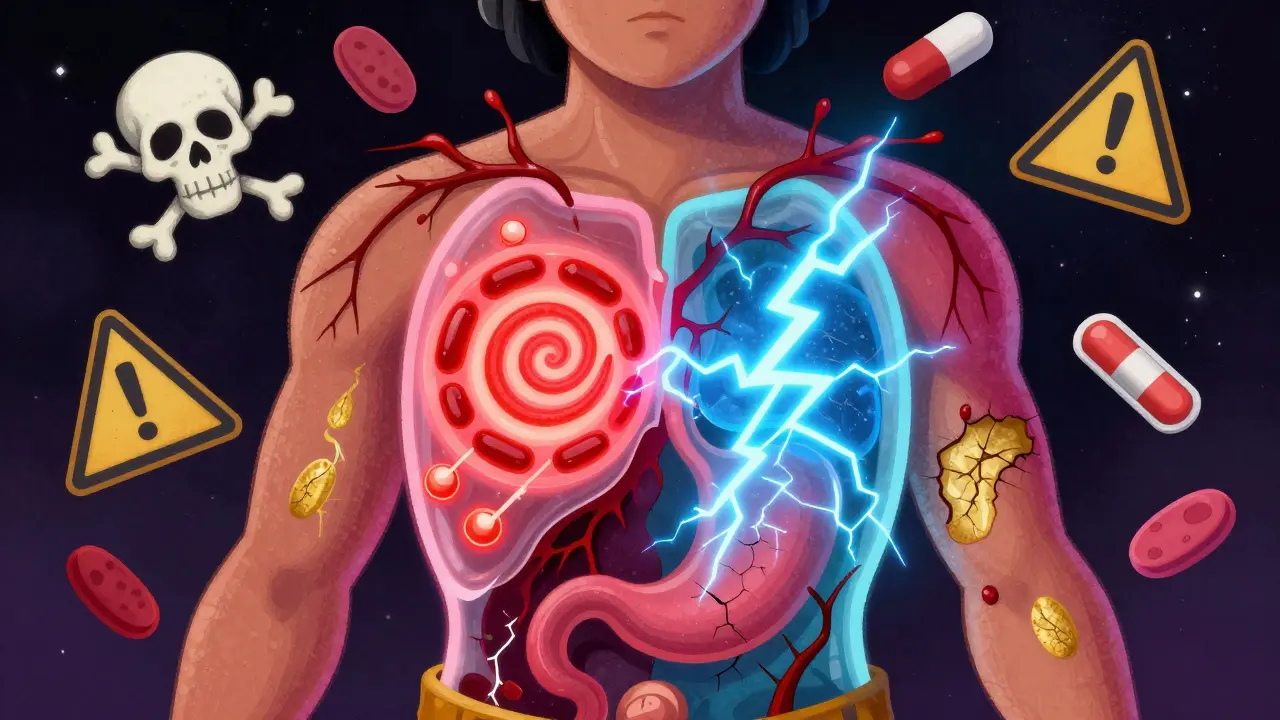
When you're on a blood thinner, even a simple pain reliever can turn dangerous. Millions of people take anticoagulants like warfarin, apixaban, or rivaroxaban to prevent clots after a stroke, deep vein thrombosis, or for atrial fibrillation. At the same time, many of them reach for ibuprofen, naproxen, or diclofenac to ease arthritis pain, headaches, or backaches. What they don’t realize is that combining these two types of drugs doesn’t just add up-it multiplies the risk of serious, sometimes fatal, bleeding.
What Happens When Blood Thinners and NSAIDs Mix?
Blood thinners work in different ways, but their goal is the same: stop clots from forming. Warfarin blocks vitamin K, which your body needs to make clotting proteins. Newer drugs like apixaban and dabigatran directly block specific clotting factors. NSAIDs-nonsteroidal anti-inflammatory drugs-work by shutting down enzymes called COX-1 and COX-2. COX-2 helps with inflammation and pain, but COX-1 is critical for protecting your stomach lining and helping platelets stick together to stop bleeding. When you take both, you’re hitting two separate systems that control bleeding. Your blood can’t clot properly because of the anticoagulant. At the same time, your platelets are weakened by the NSAID, and your stomach lining becomes more vulnerable. The result? A perfect storm for internal bleeding that can start quietly and escalate fast.The Real Risk: More Than Just Stomach Bleeding
Most people think the danger is only stomach ulcers or black stools. But a major 2024 study from Denmark, tracking over 51,000 people on blood thinners, showed the risks go far beyond the digestive tract. The study, published in the European Heart Journal, found that combining NSAIDs with anticoagulants didn’t just raise the chance of gastrointestinal bleeding-it tripled the risk of bleeding in the brain, increased lung bleeding by over 30%, and raised urinary tract bleeding by nearly 60%. Even more alarming, it caused nearly three times more cases of anemia from hidden blood loss. The numbers don’t lie. Naproxen increased bleeding risk by 4.1 times. Diclofenac raised it by 3.3 times. Even ibuprofen, often seen as the "safer" NSAID, still doubled the risk. And here’s the kicker: this happened whether people were on old-school warfarin or newer drugs like apixaban. There’s no "safe" blood thinner to pair with an NSAID.Why Ibuprofen Isn’t the Safe Choice
Many patients assume ibuprofen is okay because it’s available over the counter and marketed as mild. But the data says otherwise. While ibuprofen’s bleeding risk is lower than naproxen or diclofenac, it’s still 1.79 times higher than using a blood thinner alone. And because so many people take it regularly-sometimes daily for joint pain-it adds up. In the U.S., around 30 billion ibuprofen tablets are sold each year. That’s a lot of people unknowingly stacking risk on top of risk. Even more surprising: selective COX-2 inhibitors like celecoxib, once thought to be safer for the stomach, didn’t reduce bleeding risk either. That’s because the problem isn’t just stomach irritation-it’s the platelet effect. All NSAIDs, regardless of type, interfere with platelet function. So swapping one NSAID for another doesn’t solve the problem.
Who’s Most at Risk?
Older adults are the most vulnerable group. They’re more likely to be on blood thinners for atrial fibrillation or a history of clots. They’re also more likely to have osteoarthritis, back pain, or other chronic conditions that lead to NSAID use. The Danish study showed that even short-term NSAID use-just a few days-spiked bleeding risk. There’s no safe window. People with kidney problems, a history of ulcers, or those taking other medications like steroids or SSRIs are at even higher risk. But even healthy, young patients on blood thinners shouldn’t assume they’re immune. Bleeding doesn’t care about age or fitness. It just needs a trigger.What Should You Take Instead?
The clear, evidence-based alternative is acetaminophen (Tylenol). It relieves pain and reduces fever without affecting platelets or clotting. It doesn’t cause stomach irritation or interfere with anticoagulants. For most people on blood thinners, acetaminophen is the go-to for headaches, muscle aches, or fever. For chronic pain like arthritis, non-drug options work better than you think. Heat packs, cold therapy, physical therapy, and gentle movement can reduce pain without any drug risk. Weight management, if needed, takes pressure off joints. Topical creams with menthol or capsaicin can help localized pain without entering your bloodstream. If you absolutely must use an NSAID-for example, during a sudden gout flare-use the lowest dose for the shortest time possible. Talk to your doctor about adding a proton pump inhibitor (PPI) like omeprazole to protect your stomach. But even then, the risk of bleeding elsewhere-brain, lungs, kidneys-remains. There’s no magic shield.
What Doctors Need to Do
This isn’t just a patient problem-it’s a system problem. Too many doctors don’t ask about OTC meds. Patients don’t think of ibuprofen as a "medicine" worth mentioning. But in one study, nearly half of patients on blood thinners were using NSAIDs without their doctor knowing. Clinicians need to ask directly: "Are you taking any painkillers, even over-the-counter ones?" They need to review every prescription refill and flag NSAID use in electronic records. Health systems should build alerts that pop up when a blood thinner is prescribed alongside an NSAID. The American College of Cardiology calls this "antithrombotic stewardship." It means treating drug safety like a team sport-pharmacists, nurses, and doctors all checking in. And patients need to be part of that team.What You Can Do Today
If you’re on a blood thinner:- Stop taking any NSAID unless your doctor says it’s absolutely necessary.
- Switch to acetaminophen for pain relief.
- Check every bottle-cold medicines, menstrual pain pills, and arthritis creams often contain NSAIDs.
- Bring your full medication list (including supplements and OTCs) to every appointment.
- If you notice unusual bruising, blood in urine or stool, dizziness, or sudden headaches, get checked immediately.
Why This Isn’t Going Away
With more people living longer and needing blood thinners-and more people turning to NSAIDs for chronic pain-this combination is only becoming more common. The Danish study was one of the first to show the full scope of the danger. But awareness hasn’t caught up. Pharmacies don’t always warn you. Labels on NSAID bottles rarely mention blood thinners. Patients assume if it’s sold over the counter, it’s harmless. That’s the biggest myth of all. The truth? If you’re on a blood thinner, your body is already on a tightrope. NSAIDs are the gust of wind that pushes you over.Can I take ibuprofen if I’m on warfarin?
No. Even low-dose or occasional ibuprofen increases your risk of bleeding by nearly 80% when taken with warfarin. The risk isn’t small-it’s significant enough that doctors strongly advise against it. Use acetaminophen instead.
Are newer blood thinners safer with NSAIDs?
No. Whether you’re on warfarin, apixaban, rivaroxaban, or dabigatran, combining any of them with NSAIDs raises your bleeding risk by the same amount. The danger comes from the NSAID’s effect on platelets and stomach lining, not the type of blood thinner you’re taking.
What about aspirin? Is that okay?
Aspirin is also an NSAID and a powerful antiplatelet drug. It increases bleeding risk just like ibuprofen or naproxen. If you’re on a blood thinner, never take aspirin unless your doctor specifically prescribes it for heart protection-and even then, only under close monitoring.
Can I take NSAIDs for a few days during a flare-up?
Even short-term use raises your bleeding risk. A Danish study showed increased bleeding within just a few days of NSAID use. There’s no safe duration. If you’re on a blood thinner, avoid NSAIDs completely unless your doctor gives you a clear, documented plan with close follow-up.
What should I do if I accidentally took an NSAID?
If you took one dose of an NSAID and feel fine, monitor for signs of bleeding: unusual bruising, dark or bloody stools, red or brown urine, severe headaches, or dizziness. Call your doctor immediately. Don’t wait for symptoms. If you took more than one dose or have any symptoms, go to urgent care or the ER.
Can I use topical NSAIDs like gels or patches?
Topical NSAIDs like diclofenac gel or patches are absorbed in much smaller amounts than pills. Some studies suggest they’re safer, but they’re not risk-free. If you’re on a blood thinner, talk to your doctor before using them. Acetaminophen or non-drug therapies are still the safest choices.
Does taking a proton pump inhibitor (PPI) make it safe?
PPIs like omeprazole can reduce stomach ulcers, but they don’t protect against bleeding in the brain, lungs, or kidneys. The Danish study showed that even with PPIs, the risk of intracranial and pulmonary bleeding stayed high. PPIs help with one part of the problem-but not the whole picture.
Randall Little
January 14, 2026 AT 01:14So let me get this straight: the same pills I grab at the drugstore to kill a headache are basically a ticking time bomb if I’m on warfarin? And nobody tells you this? I mean, the label says "may cause stomach upset," but not "may cause you to bleed out internally like a scene from a horror movie?" This is the kind of thing that should be printed on every NSAID bottle in neon lights. Or at least a QR code that links to a 30-second video of someone vomiting blood. Just saying.
Acacia Hendrix
January 15, 2026 AT 13:10It’s fascinating how the pharmacodynamic interplay between COX-1 inhibition and anticoagulant-mediated thrombin suppression creates a synergistic pro-hemorrhagic milieu-particularly in the context of platelet dysfunction and gastric mucosal erosion. The Danish cohort study’s hazard ratios are statistically robust, but what’s more alarming is the cognitive dissonance in patient behavior: the normalization of OTC pharmacotherapy despite clear contraindications. The healthcare system’s failure to implement automated prescribing alerts reflects a broader epistemological neglect of pharmacovigilance as a public health imperative.
Adam Rivera
January 15, 2026 AT 18:38Hey, I just found out my mom’s been taking naproxen for her knees while on rivaroxaban. She’s 72. I didn’t even know she was on it until I saw the bottle. I’m calling her right now to switch her to Tylenol and get her to talk to her doc. Thanks for posting this-seriously. I think a lot of us just assume if it’s sold next to the gum and candy, it’s harmless. Not anymore.
Rosalee Vanness
January 16, 2026 AT 17:22I’ve been on apixaban for nearly five years now, ever since that little clot in my leg that scared the living daylights out of me-and I’ve been so careful. I’ve never taken an NSAID. I used to love ibuprofen for my migraines, but I swapped it out for heat packs, magnesium supplements, and yoga. It’s not easy, but it’s worth it. I’ve had zero bleeding episodes. And honestly? I feel more in control of my body now. It’s not just about avoiding danger-it’s about choosing a gentler, more mindful way to live. You don’t need a pill for every ache. Sometimes, your body just needs rest, warmth, and patience. I’m not saying it’s fun-I’m saying it’s possible. And you’re not alone if you’re making this switch. I’ve been there.
Trevor Davis
January 18, 2026 AT 09:12Okay so I’m gonna be real. I took ibuprofen last week because my back was killing me. I didn’t think it mattered-I’m young, I’m healthy, I’m on apixaban but I don’t feel like I’m bleeding. I’m fine. But now I’m reading this and I’m sweating. Like, I actually checked my stool. It’s brown. I think. Maybe. I don’t know what black stool looks like. I’m gonna call my doctor tomorrow. I’m scared. I’m sorry. I didn’t know. Please don’t judge me. I just wanted my back to stop hurting.
John Tran
January 20, 2026 AT 07:23Bro. I’ve been thinking about this like, all day. Like, what if the real problem isn’t the drugs? What if it’s… our relationship with pain? We live in a society that equates discomfort with failure. We can’t sit with a headache. We can’t breathe through a stiff neck. We gotta numb it. We gotta crush it. We gotta take something. But what if pain is just… your body whispering? Not screaming. Whispering. And we’ve been trained to hear only the scream. Maybe the real danger isn’t the NSAID. Maybe it’s the belief that we’re entitled to zero discomfort. Maybe the bleeding… is just the universe saying, "Hey. Slow down. Listen. You’re not a machine."
mike swinchoski
January 20, 2026 AT 19:47Stop being so dramatic. I've been on warfarin for 10 years and I take ibuprofen every day. I'm fine. Your doctor is just scared of liability. If you're healthy, you're fine. People are dying from fear, not from pills.
Trevor Whipple
January 22, 2026 AT 10:31lol you guys are freaking out over a little bleeding. I take celecoxib and Eliquis and I’m fine. You think the FDA doesn’t know this? They’d ban it if it was dangerous. Also, I think Tylenol is worse for your liver. Just saying. You’re all overreacting.
Lethabo Phalafala
January 24, 2026 AT 02:14My uncle died from a brain bleed after taking diclofenac for his arthritis. He didn’t even know he was on a blood thinner. He thought his doctor had cleared him. He was 68. He loved his morning walks. He loved his painkillers. He didn’t know he was choosing death over comfort. I cry every time I see an NSAID bottle. Please. Just listen. Please.
Lance Nickie
January 25, 2026 AT 15:12nah the real danger is doctors pushing acetaminophen. it’s toxic as hell. you’re better off just bleeding a little.
Milla Masliy
January 27, 2026 AT 05:57This is such an important post. I work in pharmacy and we see this all the time-patients grab NSAIDs like they’re candy. We try to warn them, but they’re already at the register. I wish we had a better system. Maybe a sticker on the shelf? Or a little card next to the pain aisle? Something simple. I just wish more people knew. Thank you for sharing this.