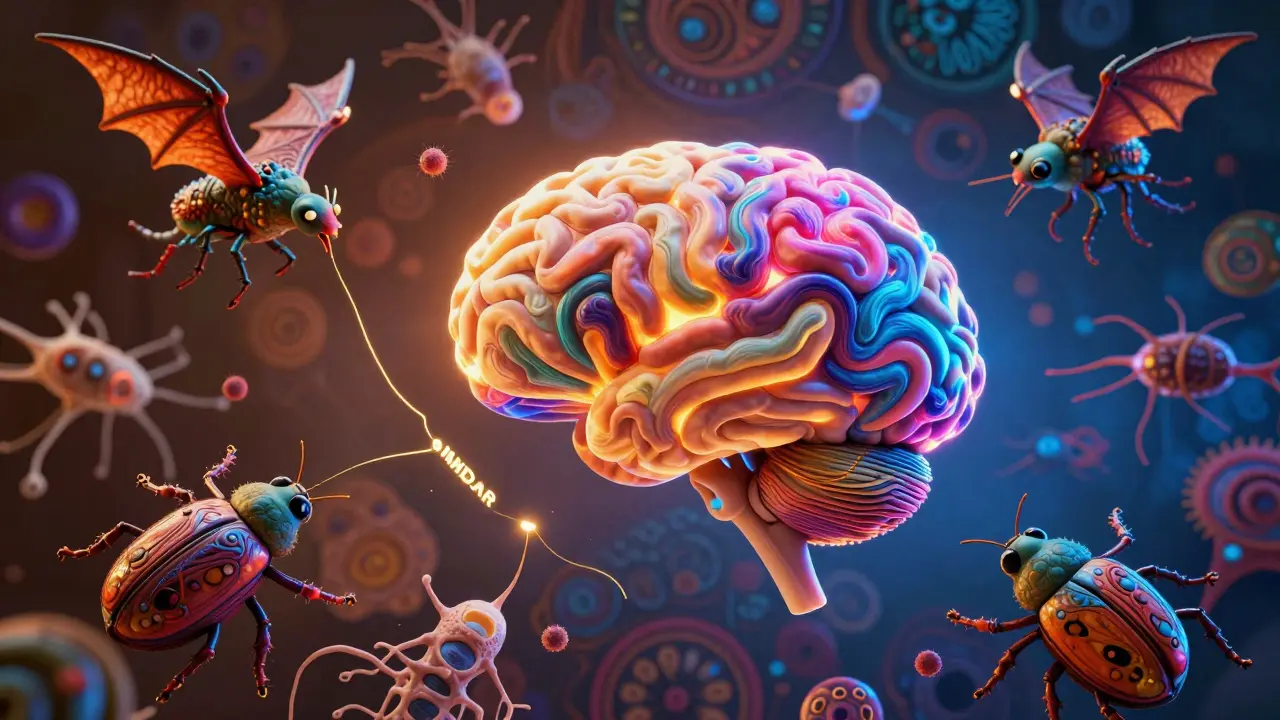
Autoimmune encephalitis isn’t something most people have heard of-until it hits close to home. It’s not a stroke, not a virus, and not a typical brain infection. It’s when your own immune system turns on your brain, attacking the very cells that control memory, behavior, and movement. The good news? If caught early, it’s one of the few neurological conditions that can be reversed. The bad news? It’s often mistaken for psychiatric illness, drug overdose, or even epilepsy. And every day you wait, the chance of full recovery drops.
What Exactly Is Autoimmune Encephalitis?
Autoimmune encephalitis (AE) is when your body produces antibodies that mistakenly target proteins in your brain. These aren’t random errors. Each antibody attacks a specific target-like the NMDA receptor, LGI1, or GABAB receptor-that helps neurons communicate. When these receptors get blocked or removed, brain signals go haywire. The result? Seizures, confusion, hallucinations, memory loss, and sometimes catatonia.
The big breakthrough came in 2007, when researchers identified anti-NMDAR encephalitis in young women with ovarian tumors. Before that, many of these patients were labeled as having schizophrenia or bipolar disorder. Now, we know AE is a distinct, treatable condition. It’s rare-about 1 in 100,000 people per year-but far more common than once thought. And it doesn’t just affect young women. It hits men, older adults, and children too.
Red Flags: When Should You Suspect AE?
Most people with autoimmune encephalitis don’t wake up sick. Symptoms creep in over days or weeks. If you or someone you know develops a mix of neurological and psychiatric symptoms, especially after a mild infection, pay attention.
- Seizures that don’t respond to medication-especially if they’re new, frequent, or involve unusual movements like facial twitching or arm jerking.
- Memory loss that’s getting worse-not just forgetting where you put your keys, but forgetting names of close family members or how to do familiar tasks.
- Psychiatric symptoms out of nowhere-paranoia, hallucinations, aggression, or extreme anxiety in someone with no prior mental health history.
- Autonomic chaos-heart rate spiking without exertion, blood pressure dropping, sweating for no reason, or trouble regulating body temperature.
- Sleep disruption-insomnia for weeks, or sleeping 16 hours a day with no energy to get up.
These aren’t isolated symptoms. They cluster. A 2025 study of 207 patients found that 85% had memory problems, 63% had sleep issues, and 42% had autonomic dysfunction. If three or more of these show up together, AE should be on the shortlist.
Also watch for prodromal symptoms: fever, headache, or diarrhea one to four weeks before neurological symptoms start. That’s a clue your immune system was already activated.
Which Antibodies Matter Most?
Not all autoimmune encephalitis is the same. Over 20 different antibodies have been found, and each one tells a different story. The two biggest categories are surface antibodies and intracellular antibodies.
Surface antibodies (anti-NMDAR, anti-LGI1, anti-CASPR2, anti-GABABR) attack proteins on the outside of neurons. These are often treatable and sometimes linked to tumors.
- Anti-NMDAR-The most common, making up 40% of cases. Typically affects women under 30. Half are linked to ovarian teratomas. Symptoms start with anxiety or insomnia, then progress to seizures, memory loss, and sometimes unresponsiveness.
- Anti-LGI1-About 15% of cases. Mostly men over 60. Classic signs: brief, repeated muscle spasms in the face and arm (faciobrachial dystonic seizures) and low sodium levels. Recovery is good if caught early.
- Anti-GABABR-5% of cases. Strongly tied to small cell lung cancer. Often presents with severe seizures and confusion. Prognosis is worse because the cancer can spread before the brain symptoms are recognized.
Intracellular antibodies (like anti-Hu, anti-Ma2) attack proteins inside neurons. These are harder to treat and usually linked to cancer. They’re less common but more dangerous.
Testing matters. Serum (blood) tests catch about 80% of cases. But CSF (spinal fluid) tests are 15-20% more sensitive-especially for anti-NMDAR. Always test both. A negative blood test doesn’t rule it out.

How Is It Diagnosed?
There’s no single test. Diagnosis relies on a mix of clinical signs, lab results, and imaging.
- CSF analysis-White blood cells are usually under 100/μL (infectious encephalitis often has hundreds or thousands). Protein is mildly elevated. Oligoclonal bands are typically negative.
- MRI brain scan-About half the time, it looks normal. When it’s abnormal, you’ll see swelling in the temporal lobes (limbic system) or patchy enhancement. This is different from infectious encephalitis, which usually shows widespread, dramatic changes.
- EEG-Abnormal in 76% of cases. Look for slow brain waves, not the periodic spikes seen in viral encephalitis. Some patients show extreme delta brushes, a pattern almost unique to anti-NMDAR encephalitis.
The 2016 diagnostic criteria (updated in 2023) help doctors put the pieces together. If you have subacute neurological decline, positive antibodies, and no infection, AE is likely.
How Is It Treated?
Treatment isn’t one-size-fits-all. It’s tiered, fast, and aggressive.
First-line therapy
- Intravenous steroids-Methylprednisolone (1 gram/day for 5 days). About 68% respond within a week.
- IV immunoglobulin (IVIg)-0.4 g/kg/day for 5 days. Works in 60-70% of cases. Often used with steroids.
Don’t wait for antibody results. If the clinical picture fits, start treatment immediately. Delaying by even a few days cuts recovery chances by 40%.
Second-line therapy
If no improvement after 7-10 days, move to stronger options:
- Rituximab-A B-cell depleter. Given weekly for 4 weeks. 55% response rate.
- Cyclophosphamide-A chemotherapy drug. Used monthly for 6 months. 48% response.
- Tocilizumab-An IL-6 blocker. Emerging option with 52% effectiveness in tough cases.
Plasma exchange (plasmapheresis) is also critical for patients who are critically ill. Five to seven sessions over 10-14 days can stabilize someone who’s in a coma or having constant seizures.
Tumor removal
One in three AE cases is triggered by a tumor. If you have anti-NMDAR encephalitis, get an ovarian ultrasound and pelvic MRI. For anti-GABABR, get a chest CT for lung cancer. If you find a tumor, remove it ASAP. Surgery alone can lead to neurological improvement in 85% of cases within four weeks.
And don’t stop screening. Up to 15% of tumors show up only after the first scan. Repeat imaging every 4-6 months for two years.

What’s the Prognosis?
Outcomes depend on timing, antibody type, and complications.
- Early treatment-Starting immunotherapy within 30 days of symptoms? 78% of patients recover well (mRS ≤2). Wait beyond 45 days? Only 42% do.
- Recovery rates-Anti-LGI1: 55% full recovery at 2 years. Anti-NMDAR: 45%. Anti-GABABR: Only 75% survive three years-mostly due to cancer.
- Long-term issues-Even those who recover aren’t always back to normal. 40% have lasting problems: memory gaps, depression, anxiety, or seizures needing meds.
- Recurrence-12-25% for anti-NMDAR. Up to 35% for anti-LGI1. Most come back within 14-22 months.
One study found that patients with low consciousness, severe memory loss, or specific EEG patterns were 87.6% more likely to have a poor outcome. That’s why risk stratification is becoming part of standard care.
Long-Term Care: Beyond the Hospital
Recovery doesn’t end when you leave the ICU. It’s a marathon.
- Cognitive rehab-12 weeks of structured memory training improves function in 65% of patients.
- Psychiatric support-SSRIs help 70% of patients with depression or anxiety after AE.
- Physical therapy-For movement disorders, 8 weeks of therapy improves motor function by 50%.
- Sleep-Melatonin (3-5 mg at bedtime) helps 60% with insomnia or hypersomnia.
- Autonomic issues-Beta-blockers work for 75% of patients with rapid heart rate.
Follow-ups every 3-6 months for the first two years are non-negotiable. This is when relapses happen.
What’s Next?
The field is moving fast. Researchers are testing drugs that block complement proteins (part of the immune attack) and newer B-cell therapies. One biomarker-GFAP-is showing promise for tracking disease activity. If validated, it could replace repeated MRIs and spinal taps.
But the biggest advance isn’t a drug. It’s awareness. More doctors are recognizing that a young woman with psychosis and seizures isn’t just “hysterical.” An older man with memory loss and low sodium isn’t just “getting old.”
Autoimmune encephalitis is rare. But it’s real. And if you act fast, it’s reversible.
Alfred Noble
February 26, 2026 AT 23:28Man, this post hit different. I had a cousin go through something like this-doctors thought it was drug use, then schizophrenia. Took 3 months before someone even considered AE. She’s fine now, but lost a year of her life. Just… don’t ignore the combo of weird behavior + seizures + sleep chaos. It’s not ‘just stress.’
Also, melatonin helped her sleep, weirdly. 5mg at night, no side effects. Would’ve saved us so much panic if we’d known sooner. Thanks for laying this out.
Matthew Brooker
February 27, 2026 AT 13:04THIS. IS. CRUCIAL. I work in ER and we see these cases all the time and still miss them. A 22yo woman came in last month screaming about demons, not eating, sleeping 18 hours a day. We thought psychosis. MRI was normal. CSF came back anti-NMDAR. She was in a coma by day 3. Started steroids that night. She’s back at college now. No one talks about how fast this moves. If you see three red flags? Don’t wait. Don’t wait for labs. Don’t wait for a psychiatrist. Start the treatment. Now.
Emily Wolff
February 28, 2026 AT 22:25How is this not standard medical curriculum? If you’re not teaching this in med school, you’re failing your students. The fact that we still misdiagnose this as bipolar or ‘hysteria’ in 2025 is a national disgrace. Also, anti-GABABR with lung cancer? That’s not ‘rare.’ It’s a ticking time bomb. Someone needs to hold oncology departments accountable.
Joseph Cantu
March 1, 2026 AT 04:03They don’t want you to know this… but what if this isn’t autoimmune at all? What if it’s 5G? Or vaccines? Or the microchips in the flu shots? I read a paper-well, a blog post by a guy who used to work at Pfizer-that said they’ve been hiding this for years. The ‘antibodies’? Lab artifacts. The ‘recovery’? Placebo. They’re just using steroids to shut people up. And the tumors? Coincidence. Or… a cover-up. Why do you think they push the ‘early treatment’ narrative? So you don’t ask questions.
Jacob Carthy
March 1, 2026 AT 09:22USA has the best doctors in the world so why are we still messing this up? We got the tech. We got the money. Why do we let some girl in Texas wait 6 weeks for a diagnosis? This is a national embarrassment. I don’t care if it’s rare. If one person dies because some doc didn’t read a paper, that’s one too many. We need mandatory AE training for all ER docs. No excuses. #FixTheSystem
Lisandra Lautert
March 1, 2026 AT 21:11Anti-LGI1 patients have the most distinctive facial twitching. It’s not just spasms. It’s rhythmic. Almost like a tic. And hyponatremia? Always check sodium. Always. I’ve seen too many patients sent home with ‘viral syndrome’ when their sodium was 118. That’s not a typo. That’s a death sentence.
Cory L
March 3, 2026 AT 02:19My sister’s recovery was wild. She went from catatonic to walking again in 3 weeks after IVIG. But the rehab? Brutal. Cognitive therapy felt like learning to walk again… but with your brain. We did 12 weeks of memory drills. She still forgets my birthday. But she’s alive. And that’s more than most get. If you’re reading this and you’re scared? You’re not alone. This stuff is survivable. Just don’t wait.
Bhaskar Anand
March 3, 2026 AT 18:41India has 1.4 billion people. How many cases are we missing? No testing. No awareness. No funding. We have doctors who think this is ‘spiritual possession.’ A woman in my village died because they gave her mantra chants instead of IVIG. This isn’t just a medical issue. It’s a moral one. The world needs to wake up.