When you walk into a pharmacy to pick up a prescription, you might see two versions of the same medicine: one with a well-known brand name and another labeled as an authorized generic. They look identical. They work the same way. But the authorized generic often costs 4% to 8% less. Why? And why does it matter to you?
What Exactly Is an Authorized Generic?
An authorized generic is not a copy. It’s the exact same drug made by the same company that makes the brand-name version. The brand-name manufacturer licenses its own product to be sold under a different label-usually at a lower price. The FDA requires these products to match the brand in every way: same active ingredient, same pills, same factory, same quality controls. There’s no difference in how they work in your body.That’s different from regular generics. Regular generics are made by other companies after the brand’s patent expires. They have to prove they’re equivalent through an FDA process called an ANDA. Authorized generics skip that step because they’re made under the original brand’s approval, known as an NDA. They’re the real thing, just without the brand name on the box.
Why Do They Cost Less?
The reason authorized generics are cheaper comes down to one thing: competition. When a brand-name drug loses its patent, the first generic company to file gets 180 days of exclusive rights to sell the generic version. That’s a big deal. Without competition, that first generic can set a high price-sometimes close to the brand’s price.But if the brand company launches its own authorized generic at the same time, everything changes. Now there are two versions of the generic on the shelf from day one. The first generic can’t charge premium prices anymore. It has to drop its price to compete with the brand’s own version. And that forces everyone else to lower prices too.
Studies from the Federal Trade Commission show that when an authorized generic enters the market at the same time as a regular generic, pharmacy prices drop 8.4% to 10.3% compared to when no authorized generic is present. For pharmacies buying in bulk, the discount can be even bigger-13% to 18% lower than if only one generic were available.
How This Affects Your Pocket
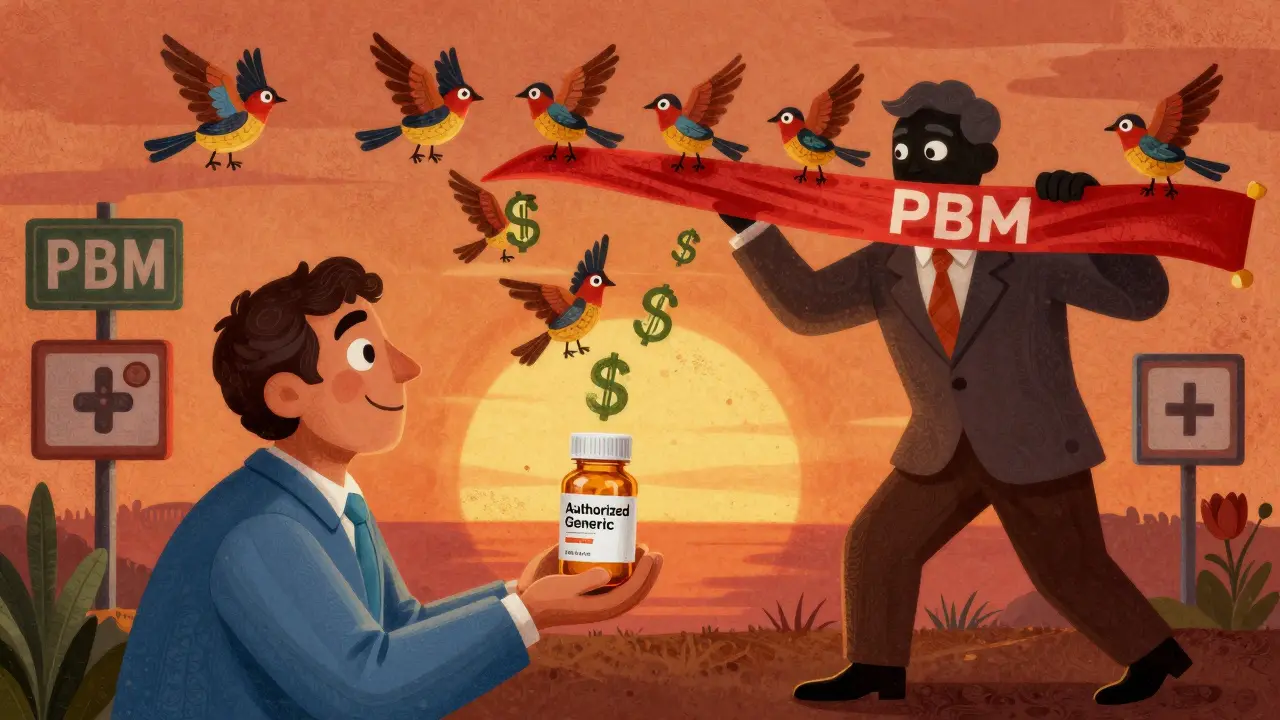
You might think, “If it’s the same drug, why not just buy the brand?” The answer is cost. Even a small price difference adds up. If your brand-name medication costs $100 a month, switching to the authorized generic could save you $4 to $8 every month. That’s $48 to $96 a year. For people on multiple medications, those savings become significant.But here’s the catch: your insurance plan might not make it easy. Pharmacy Benefit Managers (PBMs) control which drugs go on which tier in your plan. Sometimes, the brand-name drug and the authorized generic are placed on the same tier. That means you pay the same copay for both. But if the PBM puts the authorized generic on a lower tier, your copay drops. You need to ask your pharmacist: “Is the authorized generic covered at a lower cost than the brand?”
A 2022 analysis of 1.2 million Medicare Part D patients found that when authorized generics were placed on the same tier as regular generics, medication adherence improved by 8.2 percentage points. People took their meds more consistently because they could afford them.
Real-World Examples
One of the most talked-about cases was the EpiPen. In 2016, Mylan raised the price of the brand-name EpiPen to $600 for a two-pack. Public outrage followed. Then Mylan released an authorized generic-same device, same epinephrine-for $300. The price didn’t drop because of charity. It dropped because competition forced it.Another example is Gilead’s hepatitis C drugs, Harvoni and Epclusa. Before their patents expired, Gilead launched authorized generics to keep market share as cheaper alternatives loomed. The strategy worked. Patients got access to the same medicine at a lower price, and Gilead still made money.
These aren’t rare cases. Since 2010, 67% of brand-name drugmakers have used authorized generics for at least one product. The pharmaceutical industry spends about $1.8 billion a year on marketing and distributing them.
Why Aren’t They Always Cheaper?
You might wonder: if they’re the same drug, why aren’t they always the cheapest option? The answer lies in how insurance plans are structured. Some PBMs still favor the brand-name version because they get rebates from the manufacturer. Even if the authorized generic is cheaper, the plan might not pass the savings to you.Also, some pharmacies don’t stock authorized generics because they’re not always profitable for them. If the pharmacy gets the same reimbursement for the brand and the authorized generic, they might just keep the brand on the shelf-it’s easier to manage.
That’s why it’s important to ask. Don’t assume the generic you’re given is the cheapest. Ask your pharmacist: “Is there an authorized generic for this? And is it covered at a lower cost?”
What About the Future?
Authorized generics are here to stay. With the Inflation Reduction Act capping out-of-pocket drug costs for Medicare beneficiaries at $2,000 a year, manufacturers have more incentive than ever to offer lower-cost versions. Authorized generics help them keep customers loyal while still making a profit.Regulators are watching too. The FTC has raised concerns that sometimes, brand companies use authorized generics as a way to delay broader generic competition. For example, if a brand company pays a generic manufacturer to hold off on launching their version, and instead launches its own authorized generic, that’s a problem. The FTC calls these “pay-for-delay” deals. Courts and lawmakers are cracking down.
Still, when used fairly, authorized generics are a win for patients. They bring down prices faster. They increase access. And they give you a better option than paying full price for a drug that’s no longer under patent.
What You Can Do
Here’s how to make sure you’re getting the best deal:- Ask your doctor if an authorized generic is available for your prescription.
- Call your pharmacy and ask: “Do you carry the authorized generic for this drug?”
- Check your insurance formulary. Is the authorized generic on a lower tier than the brand?
- If your copay is the same for both, ask if you can switch to the authorized generic for a lower price.
- Use tools like GoodRx or SingleCare to compare prices between brand, authorized generic, and regular generic versions.
You don’t need to be a pharmacy expert to save money. You just need to ask the right questions. The drug in your hand might be the same as the brand-but the price doesn’t have to be.
Are authorized generics as safe as brand-name drugs?
Yes. Authorized generics are made in the same facility, with the same ingredients, and under the same quality controls as the brand-name drug. The FDA requires them to be identical in safety, strength, dosage, and performance. There is no difference in how they work in your body.
Why don’t pharmacies always stock authorized generics?
Some pharmacies don’t stock them because they get the same reimbursement from insurance for both the brand and the authorized generic. If there’s no extra profit, they may just keep the brand on the shelf. It’s also possible the pharmacy doesn’t have a supplier for the authorized version. Always ask-many pharmacies can order it if it’s not on the shelf.
Can I switch from a brand-name drug to an authorized generic without my doctor’s approval?
In most cases, yes. Pharmacists can substitute an authorized generic for a brand-name drug if it’s allowed by your state’s laws and your insurance plan. But it’s always a good idea to check with your doctor or pharmacist first, especially if you’re on a medication with narrow therapeutic windows, like thyroid drugs or seizure medications.
Do authorized generics have the same side effects as brand-name drugs?
Yes. Since they contain the exact same active ingredient and are manufactured to the same standards, authorized generics have the same side effect profile as the brand-name version. Any differences in how you feel are likely due to inactive ingredients, but these are minimal and rarely cause issues.
How do I find out if my drug has an authorized generic?
You can check the FDA’s quarterly list of authorized generics on their website. You can also ask your pharmacist, search online using your drug’s generic name + "authorized generic," or use tools like GoodRx, which often list authorized generic options alongside regular generics and brand names.
Dayanara Villafuerte
January 19, 2026 AT 07:12OMG I just found out my $120/month blood pressure med has an authorized generic for $45?? 😱 I’ve been overpaying for years. Thanks for this! 🙌
Andrew Qu
January 19, 2026 AT 22:58That’s actually a really common scenario. A lot of people don’t realize the brand and generic are identical. The key is asking your pharmacist - not assuming the first option they give you is the cheapest. Small questions = big savings.
Naomi Keyes
January 20, 2026 AT 23:36While I appreciate the intent behind this article, I must point out that the FTC’s findings are often misinterpreted. The 8.4% to 10.3% price drop is an average - and in many cases, it’s offset by reduced market entry by independent generics due to brand-owned competition. This isn’t consumer empowerment; it’s corporate strategy disguised as relief.
Moreover, the claim that authorized generics increase adherence is misleading. Adherence improved because the *price* dropped - not because the drug was ‘authorized.’ The same effect would occur with any generic, regardless of origin.
Also, why is no one discussing the fact that these ‘authorized’ versions are often marketed with deceptive packaging? The label says ‘generic,’ but the bottle is nearly identical to the brand - designed to confuse elderly patients into thinking they’re getting the ‘real’ thing.
And let’s not forget: PBMs still pocket the rebates. You think you’re saving money? The pharmacy gets $0.50 more per script, the PBM gets $12, and you get… a slightly lower copay. The system is rigged.
It’s not that this isn’t useful information - it’s that it’s incomplete. And incomplete information in healthcare is dangerous.
christian Espinola
January 22, 2026 AT 21:42Authorized generics? More like corporate collusion. The FDA allows this loophole because the big pharma lobbyists wrote the rules. Same factory? Same pill? Sure. But who’s to say the quality control isn’t relaxed on the ‘generic’ line? They don’t need to prove equivalence - they already own the NDA. That’s not competition. That’s a monopoly with a new label.
And the EpiPen example? Mylan didn’t lower prices because of ‘competition.’ They lowered them because they were being sued. The authorized generic was a PR stunt to avoid regulation. You think they care about your wallet? They care about their stock price.
Every time you buy an ‘authorized generic,’ you’re funding the same company that just hiked prices 500% last year. This isn’t saving money. It’s gaslighting.
Danny Gray
January 24, 2026 AT 03:10So… if the drug is literally the same, why does the brand name cost more? Is it the placebo effect? Or just the cost of advertising a logo? If I take a pill with the same active ingredient, same manufacturer, same factory, same everything… and I’m told it’s ‘brand’… do I feel better? Or do I just feel like I’m being scammed?
Maybe the real question isn’t ‘why are generics cheaper’ - it’s ‘why do we still care about brand names?’
Our entire healthcare system is built on illusion. We pay for trust. We pay for marketing. We pay for the feeling that ‘this one is better.’ But science says otherwise.
So… why are we still buying the $100 bottle when the $96 one is identical?
Because we’ve been trained to.
Wendy Claughton
January 25, 2026 AT 10:30I just switched my dad to the authorized generic for his cholesterol med… and he cried. Not because he was sad - because he finally felt like he wasn’t being exploited. He’s on fixed income. Every dollar counts. This isn’t just about savings - it’s about dignity.
Thank you for writing this. I’ve been telling people for years to ask their pharmacist… but no one listens. Maybe now they will.
kenneth pillet
January 27, 2026 AT 06:35pharmacist said they dont stock it cause the rebate is higher on the brand. so they keep the expensive one. even if its the same pill. wild right?
Andrew McLarren
January 28, 2026 AT 16:25As someone who has worked in pharmaceutical compliance for over two decades, I can confirm that authorized generics are not only therapeutically equivalent but often subject to stricter internal quality audits than their branded counterparts - because the parent company has its reputation on the line. The notion that they are somehow ‘second-tier’ is a dangerous myth.
Moreover, the FTC’s data on price reductions is robust and peer-reviewed. The 8.4% to 10.3% reduction is not an outlier; it is a consistent trend across dozens of drug classes. The savings are real, and they are measurable.
That said, I agree with the concerns raised about PBM rebates and pharmacy incentives. These structural issues are not solved by authorized generics alone. Systemic reform is required. But that does not negate the immediate benefit patients receive today.
Let us not confuse a partial solution with a failure. Authorized generics are a legitimate, FDA-sanctioned, evidence-based tool for reducing drug costs. We should advocate for their wider availability - not dismiss them because the broader system remains flawed.
Selina Warren
January 30, 2026 AT 05:35You think this is bad? Wait till you find out how many ‘authorized generics’ are actually manufactured in China, then repackaged in the U.S. with a new label. The FDA doesn’t inspect every single batch. And if you think the ‘same factory’ means ‘same country’ - you’re wrong. The pill you take might’ve been made in Shanghai and shipped to Ohio to be labeled ‘authorized.’
Don’t get me wrong - I’m not anti-generic. I’m anti-illusion. If you want to save money, buy from a verified Canadian pharmacy. At least they have real oversight.
Andrew Short
January 30, 2026 AT 23:38So you’re telling me I’ve been paying $200 for a pill that costs $5 to make, and I’m supposed to be grateful because the company gave me a slightly cheaper version of the same pill? You’re not saving me - you’re just letting me know I’ve been robbed for a decade. Congrats. Now go tell your doctor to stop prescribing the brand. Oh wait - they’re getting kickbacks too.
Stacey Marsengill
February 1, 2026 AT 07:30I used to think I was being smart buying the brand - ‘better quality,’ I told myself. Then I found out my thyroid med’s authorized generic was made by the same company, in the same building, with the same chemists… and I felt like a sucker. I cried in the pharmacy aisle. Not because I was sad - because I was furious. Why did no one tell me this before?
Now I ask every time. And I tell everyone I know. Because this isn’t just about money. It’s about trust. And someone stole mine.
Zoe Brooks
February 1, 2026 AT 20:31Just switched to the authorized generic for my antidepressant. No difference in how I feel. No side effects. Same pill. Just… cheaper. Why do we make healthcare so complicated? It’s just medicine. Let’s make it simple.